<?xml version="1.0" encoding="UTF-8"?>
<feed xmlns="http://www.w3.org/2005/Atom">
    <title>Mitsue-Links' UX Blog</title>
    <link rel="alternate" type="text/html" href="https://www.mitsue.co.jp/english/global_ux/blog/" />
    <link rel="self" type="application/atom+xml" href="https://www.mitsue.co.jp/english/global_ux/blog/atom.xml" />
    <id>tag:www.mitsue.co.jp,2014-11-17:/english/global_ux/blog//8</id>
    <updated>2025-05-09T01:06:45Z</updated>
    <subtitle>UX Blog【英語版】</subtitle>
    <generator uri="http://www.sixapart.com/movabletype/">Movable Type</generator>

<entry>
    <title>Uncertainty Avoidance, Culture &amp; UX Research</title>
    <link rel="alternate" type="text/html" href="https://www.mitsue.co.jp/english/global_ux/blog/202505/09_1000.html" />
    <id>tag:www.mitsue.co.jp,2025:/english/global_ux/blog//8.2584</id>

    <published>2025-05-09T01:00:00Z</published>
    <updated>2025-05-09T01:06:45Z</updated>

    <summary>It&#8217;s a well-known fact that Japan&amp;...</summary>
    <author>
        <name>UXリサーチャー 隅田</name>
        
    </author>
    
    
    <content type="html" xml:lang="en-us" xml:base="https://www.mitsue.co.jp/english/global_ux/blog/">
        <![CDATA[<p>It&#8217;s a well-known fact that Japan&#8217;s transportation system is one of the most punctual in the world. Trains leave on time, to the minute, sometimes to the second. But have you ever wondered why that is? Is it because the country values rules? Maybe. But then, why does Japan value rules so much? What&#8217;s behind that mindset? Japan is known to be one of the most rule-driven societies in the world, though I&#8217;d argue Singapore might take the lead. Still, Japan&#8217;s relationship with rules and structure is deeply tied to a concept in cross-cultural psychology called uncertainty avoidance.</p>

<h2>What is uncertainty avoidance?</h2>
<p>Uncertainty avoidance is a cultural dimension developed by Geert Hofstede.<sup>1</sup> It describes how comfortable (or uncomfortable) people in a society are with ambiguity, unpredictability, and the unknown. In high uncertainty avoidance cultures, people tend to:

<ul>
<li>Prefer rules and structure.</li>
<li>Value long-term employment and job security.</li>
<li>Avoid risk.</li>
<li>Emphasize tidiness, order, and emotional restraint.</li>
<li>Resist change.</li>
</ul>
</p>

<p>Countries are ranked on a scale from 0 to 100. The higher the number, the stronger the preference for avoiding uncertainty. The United States, for example, scores a 46&#8212;moderate to low. That means people in the U.S. are generally more tolerant of uncertainty and ambiguity. There&#8217;s more comfort with risk-taking, flexible thinking, and informal communication. Critical thinking and problem-solving are emphasized in education, and personal initiative is generally encouraged. Japan, on the other hand, scores a 92&#8212;one of the highest in the world.<p>

<h2>So, what does high uncertainty avoidance look like in Japan?</h2>
<p>Let&#8217;s go back to transportation. Punctuality and strict schedules are ways to eliminate uncertainty. If everything runs on time, people know what to expect, and there&#8217;s less anxiety about the unknown.
But it goes further than trains. There&#8217;s resistance to change in many aspects of life; like outdated websites still in use or the notoriously slow political reforms. Another interesting example is the decision-making style in traditional Japanese companies: <i>ringi</i>.</p>

<p><i>Ringi</i> is a bottom-up decision-making process. When someone has a proposal or idea, it doesn&#8217;t go straight to the boss. Instead, it circulates among peers and managers for approval (often using a formal document called a <i>ringi-sho</i>), collecting consensus before reaching a final decision-maker. The emphasis is on harmony and group agreement rather than speed or bold individual action.</p>

<p>It&#8217;s not just business. Japan&#8217;s communication style also reflects uncertainty avoidance. Japanese is a high-context language, which means meaning is often implied rather than stated directly. People rely on shared cultural understanding, etiquette, and context to interpret meaning. This reduces the risk of misunderstandings, but it can also make communication ambiguous to others.</p>

<h2>So why does Japan score so high on this scale?</h2>
<p>There are a few likely reasons. One big factor that is often cited is Japan&#8217;s frequent exposure to natural disasters (earthquakes, tsunamis and typhoons).<sup>2</sup> Being prepared isn&#8217;t optional; it&#8217;s a way of life. There&#8217;s also a strong emphasis on social harmony, conformity, and avoiding disruption (as talked about in a previous blog). Together, these shape a culture where predictability is valued, and ambiguity can feel threatening.</p>

<h2>Uncertainty Avoidance in User Research</h2>
<p>Uncertainty avoidance doesn&#8217;t just show up in society, it also impacts how people respond in user research. Now, this is a big topic (too big for just one blog post), but I want to introduce the idea briefly. In user research, uncertainty avoidance shows up as anxiety around ambiguous tasks or open-ended questions.<sup>3</sup> It also affects how participants interpret the purpose of the research itself.</p>

<p>This is anecdotal but based on the experience of our user researchers: participants in Japan often treat research sessions like a job. They want to do well. They want to give &#8220;good&#8221; answers. And sometimes, they worry that their responses might disappoint the moderator, or worse, the client silently observing in the background. This makes certain generative methods tricky. For example: 
<ul>
<li>Open-ended prompts can feel stressful. Participants often ask, &#8220;What&#8217;s the right answer?&#8221;</li>
<li>Projective or speculative techniques might fall flat.</li>
<li>Ambiguity can create hesitation, silence, or even discomfort.</li>
</ul>
</p>

<p>To reduce participant anxiety, researchers often adjust their approach. Questions are made more specific. Instructions are repeated clearly. Interviewers work hard to create a sense of safety and reassurance. All of this helps but it also means we may miss out on the unexpected insights that come from letting people roam freely in their responses. That&#8217;s the tradeoff: structure increases clarity and comfort but can reduce spontaneity and surprise. But that&#8217;s not always a bad thing.</p>

<p>In high uncertainty avoidance cultures, what we gain is often overlooked. Specific, structured questioning can lead to highly accurate, thoughtful, and useful feedback. Participants may take the task more seriously and give answers grounded in real-life experience. There&#8217;s less noise to sort through. So, while we might lose some &#8220;creative&#8221; surprises, we gain a type of reliability and depth that&#8217;s just as valuable, especially when the goal is to refine, validate, or test.</p>

<h2>Conclusion</h2>
<p>Uncertainty avoidance describes how people in a culture deal with ambiguity. In high uncertainty avoidance countries like Japan, this means a preference for structure, clarity, and predictability. In user research, this translates into the need for more specific and carefully worded questions. Yes, it can make open-ended exploration more difficult. But it can also lead to clearer, more grounded insights, if we know how to design for it.</p>

<h2>Key Takeaways</h2>
<p>
<ul>
<li>Uncertainty avoidance affects both daily life and user research. It&#8217;s a cultural tendency to reduce ambiguity, which shows up in things like punctual trains and structured interviews.</li>
<li>In high uncertainty avoidance cultures, participants often prefer clarity. Ambiguity can lead to hesitation or discomfort, so questions need to be carefully framed.</li>
<li>Adjusting research methods isn&#8217;t a limitation, it&#8217;s a strength. Specificity can lead to rich, accurate insights, even if we lose some unpredictability.</li>
</ul>
</p>

<h2>References</h2>

<p>
<small>
<sup>1</sup>Snitker, Thomas Visby. &#8220;Uncertainty Avoidance - an Overview | ScienceDirect Topics.&#8221; Sciencedirect.com, 2011. https://www.sciencedirect.com/topics/computer-science/uncertainty-avoidance.<br>
<sup>2</sup>Scroope, Chara. &#8220;Japanese Culture - Core Concepts.&#8221; Cultural Atlas. Mosaica, 2021. https://culturalatlas.sbs.com.au/japanese-culture/japanese-culture-core-concepts.<br>
<sup>3</sup>Lee, Jung-Joo, and Kun-Pyo Lee. &#8220;Cultural Differences and Design Methods for User Experience Research: Dutch and Korean Participants Compared.&#8221; <i>Proceedings of the 2007 Conference on Designing Pleasurable Products and Interfaces</i>, 2007. https://doi.org/10.1145/1314161.1314164.
</small>
</p>
]]>
        
    </content>
</entry>

<entry>
    <title>Understanding Future Generations - Part 2: UX Research</title>
    <link rel="alternate" type="text/html" href="https://www.mitsue.co.jp/english/global_ux/blog/202504/21_1000.html" />
    <id>tag:www.mitsue.co.jp,2025:/english/global_ux/blog//8.2569</id>

    <published>2025-04-21T01:00:00Z</published>
    <updated>2025-04-21T02:29:55Z</updated>

    <summary>In part 1 of this blog series, we discus...</summary>
    <author>
        <name>UXリサーチャー 隅田</name>
        
    </author>
    
    
    <content type="html" xml:lang="en-us" xml:base="https://www.mitsue.co.jp/english/global_ux/blog/">
        <![CDATA[<p>In part 1 of this blog series, we discussed the importance and challenges of understanding the values of new generations. When faced with unfamiliar values, people often try to interpret them using existing knowledge and experiences. However, this can be like using a cookie cutter&#8212;forcing unfamiliar values into familiar shapes. This results in thinking we understand these new values, when we may actually be distorting them.</p>

<p>In this part 2, we&#8217;ll see how we can avoid this kind of cutting from mental molds and instead approach new generations&#8217; values as they truly are with examples from the perspective of UX research.</p> 

<h2>Understanding future generations</h2> 

<p>Let&#8217;s take a step back and consider this in the context of conventional marketing methods. A common approach is quantitative research, such as surveys, segmentation analyses, and 4P/4C analyses. These methods classify the market based on factors like gender, age, or behavior, and marketing decisions are then made according to the characteristics of each segment. This segmentation process is similar to the previously mentioned mental mold cutting concept, trying to fit consumers into predefined categories. However, people cannot be categorized simply by their gender, age, and/or behavioral factors, as they each have a unique mix of characteristics and values.</p>

<p>Take, for example, the beer company case we discussed in part 1. Their marketing followed this conventional approach:</p> 

<p>
<ol>
<li>Wanting to incorporate <i>emoi</i> into their marketing, they surveyed Gen Z consumers. Respondents were asked to choose the option that best represented <i>emoi</i> to them, from choices like going to Disney with friends, attending a local festival, watching a nostalgic movie, or listening to music from their childhood.</li>
<li>Based on the survey results, the company concluded that nostalgia and slightly earlier times (80s & 90s) were central to the concept of <i>emoi</i>.</li>
<li>Acting on this conclusion, they released bottles with a design that attempted to bring a retro feel to their consumers and carried out a campaign. In other words, effectively defining <i>emoi</i> as retro.</li>
</ol>
</p>

<p>UX research offers an alternative approach to help break free from these mental molds. UX research is a method of directly listening to users and observing their behaviors through interviews and/or ethnography to obtain real data about their thoughts and lives. This approach allows us to capture individuals&#8217; perspectives as they truly are.</p>

<p>Here are two examples of how UX research helped and succeeded in capturing Gen Z values as they are without forcing them into predefined categories.</p> 

<h2>Example 1: Content site</h2>

<p>A company launching a new content site invited Gen Z users to collaborate on the project and contribute new ideas. When considering what features to add, Gen Z participants provided suggestions based on their real-life perspectives. One idea was to include the ability to quote other users in articles, as they value the opinions of like-minded users.</p> 

<p>During the design phase for article pages, a team member suggested that Gen Z likely prefers shorter videos, such as TikToks or YouTube videos played at double speed, because they are highly time-conscious. Based on this assumption, they proposed making articles as concise as possible, focusing primarily on summaries. However, the Gen Z participants pushed back, expressing that this wasn&#8217;t necessarily true. Some preferred to take their time reading an article carefully, paying attention to details like photos.</p>

<p>By involving Gen Z members in the design process, the company allowed them to express their opinions freely, without forcing them into predefined categories. Notably, by actively including them in efforts to understand younger generations, which has a high risk of causing discrepancies and divergence, the company succeeded in streamlining the process. This approach is also called participatory design.</p>

<h2>Example 2: Confectionary company</h2> 

<p>For the final example, let&#8217;s look at a confectionery company&#8217;s project. They aimed to develop a new type of sweet specifically for Gen Z. However, like the previous company, they struggled to encourage Gen Z to engage with them. To address this, they set up a temporary office in a city popular among young people, making it easier for their team to observe their target demographic in a natural setting.</p>

<p>At the start of the project, one team member hypothesized that young consumers would prefer sweets with high-end packaging designs. However, after observing what kinds of sweets young people were actually buying, they were surprised to find that simple, common designs were more popular. This led them to reconsider their approach. Thanks to their location, they were able to interview young people as they entered the city. They found that younger people prefer sweets that they can eat with one hand, so they can hold their phone in the other, rather than focusing on the packaging.</p> 

<p>By immersing themselves in an environment where young people naturally spent time, the company was able to study Gen Z&#8217;s real behaviors without imposing assumptions or mental molds. This approach is known as a living lab.</p> 

<br>

<p>Both examples show the importance of approaching Gen Z without preconceived notions, capturing their values as they truly are. However, it&#8217;s important not to assume that Gen Z is inherently realistic or inclusive based on these studies, as that would be another form of categorization. Instead, set aside preconceptions and ask: What values do they have? What are they thinking? By doing so, you can construct an environment that makes it easier to understand newer values.</p> 

<h2>Key takeaways</h2>

<p>
<ul>
<li>Traditional marketing methods, such as surveys and segmentation analysis, often classify consumers (new generations in our case) based on predefined characteristics like gender, age, or behavior.</li>
<li>This approach risks cutting from our mental molds and potentially distorting the true values and perspectives of new generations.</li>
<li>To prevent this, look at the actions and opinions of the target group themselves and carefully observe them so that they do not automatically fall into a preconceived notion and perceive them as they truly are. UX research can help you with this.</li>
</ul>
</p>
]]>
        
    </content>
</entry>

<entry>
    <title>Understanding Future Generations - Part 1: Mental Molds</title>
    <link rel="alternate" type="text/html" href="https://www.mitsue.co.jp/english/global_ux/blog/202504/07_1000.html" />
    <id>tag:www.mitsue.co.jp,2025:/english/global_ux/blog//8.2564</id>

    <published>2025-04-07T01:00:00Z</published>
    <updated>2025-04-07T02:27:01Z</updated>

    <summary>Lives and values are changing immensely ...</summary>
    <author>
        <name>UXリサーチャー 隅田</name>
        
    </author>
    
    
    <content type="html" xml:lang="en-us" xml:base="https://www.mitsue.co.jp/english/global_ux/blog/">
        <![CDATA[<p>Lives and values are changing immensely as technology continues to advance. At the forefront of these changes are younger generations, who bring new perspectives and shape society and markets in new ways. It is vital to understand these generations and learn how to appeal to them in order to adapt to these changing times and create better designs for the future. However, this is easier said than done. This blog will explore key considerations when attempting to accurately capture the perspectives and values of younger generations.</p>

<h2>A Generation Z Japanese slang word</h2> 
<p>To illustrate the challenge of understanding new generational values, let&#8217;s look at a popular slang term among Japanese youth: <i>emoi</i> (eh-moy). This word is said to have originated from the English word &#8220;emotional,&#8221; but for Japan&#8217;s Generation Z, <i>emoi</i> carries a wide range of meanings. Let&#8217;s look at a few examples.</p> 

<p>Take a look at these two pictures of pudding at a café. A Gen Z person would likely say that the left picture is <i>emoi</i>, while the right one is not.</p>  

<br>
<div class="c-media">
<div class="c-media__image">
<img src="https://www.mitsue.co.jp/english/global_ux/blog/img/20250407_01.png" width="933" height="466" alt="two different pictures of cafe style pudding"></div>
<p class="c-media__caption -small">Cafe style pudding</p></div>
<br>

<p>Now, consider these photos of a train station platform. Again, the left image could be described as <i>emoi</i>, but not the right one.</p> 

<br>
<div class="c-media">
<div class="c-media__image">
<img src="https://www.mitsue.co.jp/english/global_ux/blog/img/20250407_02.png" width="954" height="317" alt="two different pictures train station platforms"></div>
<p class="c-media__caption -small">Train station platforms</p></div>
<br>

<p>Finally, here are two nearly identical images. Yet, only the left one is considered <i>emoi</i>.</p>

<br>
<div class="c-media">
<div class="c-media__image">
<img src="https://www.mitsue.co.jp/english/global_ux/blog/img/20250407_03.png" width="869" height="488" alt="two pictures of a flower garden with different filters"></div>
<p class="c-media__caption -small">Flower garden with different filters</p></div>
<br>

<p>What do you think? Do you understand what qualifies as <i>emoi</i> and what doesn&#8217;t?</p>

<h2>Other generations struggle to understand <i>emoi</i></h2>
<p>Many of you might be thinking that <i>emoi</i> seems difficult to define. This ambiguity has led some Japanese companies to incorporate <i>emoi</i> into their marketing strategies in an attempt to appeal to Gen Z. However, these efforts often fail, suggesting that the concept is likely difficult for them to grasp.</p> 

<p>Let&#8217;s take a look at one example. A beer company, noticing that younger generations were drinking less beer, decided to use <i>emoi</i> in their marketing. They designed a beer bottle they hoped Gen Z would perceive as <i>emoi</i> and launched a campaign encouraging consumers to post photos of it on social media. The most <i>emoi</i>-esque photos would win prizes.</p>

<br>
<div class="c-media">
<div class="c-media__image">
<img src="https://www.mitsue.co.jp/english/global_ux/blog/img/20250407_04.png" width="884" height="554" alt="a fake beer company's bottle design"></div>
<p class="c-media__caption -small">Retro beer bottle design</p></div>
<br>

<p>Unfortunately, the campaign did not resonate with Gen Z. Instead, the majority of participants were from older generations. This approach didn&#8217;t align with the true essence of <i>emoi</i>. It was too forced, too obviously trying to appeal to younger audiences, making it feel unnatural.</p>

<p>At a first glance, the campaign seemed to have properly understood and apply the concept of <i>emoi</i>, so why did it end in failure? Let me explain.</p> 

<h2>Challenges in understanding new values</h2>  
<p>The gap in understanding is due to the habits people tend to fall into when trying to understand something new, like the values held by younger generations. We refer to this characteristic as cutting shapes from our mental molds.</p> 

<p>Seeing what you know so far about the word <i>emoi</i>, how would you describe it? When this question was posed to unfamiliar generations and non-Japanese speakers, we heard plenty say it seems similar to the English words &#8220;retro&#8221; or &#8220;nostalgic.&#8221; Since retro aesthetics and vintage trends are familiar to all generations, it&#8217;s easy to assume they are the same as <i>emoi</i>. This is where the problem arises. When we want to understand a complex or unfamiliar concept, we sometimes replace it with similar and more familiar concepts.</p> 

<p>A personal anecdote further illustrates this point. There&#8217;s a traditional piece of clothing in Japan called a hakama. I had a conversation with one of previous colleagues from the US who said that they think it&#8217;s similar to a kimono (another type of traditional clothing). I originally agreed with this as hakama and kimonos have many things in common and really have very little differences.</p> 

<p>However, she later told me about how she wore a hakama to her friend&#8217;s wedding here in Japan. The other guests were wearing kimonos, so she was the only wearing a hakama. She explained how she felt very out of place and a little embarrassed. The fact is, kimonos and hakama have detailed and complex differences in the occasions and rules for wearing them. Not understanding the differences and thinking them one and the same, resulted in this cultural misunderstanding. Similarly, thinking that <i>emoi</i> and retro are the same thing can do the same. In other words, if we ignore the complex differences between <i>emoi</i> and retro, we oversimplify its meaning, which can lead to misunderstandings.</p>  

<h2>Stages of cutting from a mental mold</h2> 

<p>1. As previously mentioned, <i>emoi</i> is a concept that is difficult to clearly define. Imagine it looks like the following figure; something that has a unique outline and complex irregularities.</p>

<br>
<div class="c-media">
<div class="c-media__image">
<img src="https://www.mitsue.co.jp/english/global_ux/blog/img/20250407_05.png" width="740" height="487" alt="a unique shape representing emoi"></div>
<p class="c-media__caption -small">The shape of <i>emoi</i></p></div>
<br>

<p>2. Now let&#8217;s say we replace the concept of <i>emoi</i> with the concept of retro, which feels similar. As shown in the following diagrams, this results in the shapes overlapping and diverting from the original shape of <i>emoi</i>.</p>

<br>
<div class="c-media">
<div class="c-media__image">
<img src="https://www.mitsue.co.jp/english/global_ux/blog/img/20250407_06.png" width="512" height="323" alt="a rectangle representing retro as a concept"></div>
<p class="c-media__caption -small">The shape of retro</p></div>

<br>

<div class="c-media">
<div class="c-media__image">
<img src="https://www.mitsue.co.jp/english/global_ux/blog/img/20250407_07.png" width="536" height="347" alt="the shapes of retro and emoi overlapping each other"></div>
<p class="c-media__caption -small">The shapes of <i>emoi</i> and retro overlapping</p></div>
<br>

<p>As we can see, the unfamiliar concept of <i>emoi</i> becomes somewhat clearer and easier to understand.<p> 

<p>3. However, what are we also doing at the same time? To help paint a picture, imagine using a cookie cutter to cut out a shape from some cookie dough. The part of the dough that fits inside the &#8220;mold&#8221; is left behind, while the parts that don&#8217;t are cut off, leaving the final shape of the dough with the same shape as the mold.</p>

<p>In the illustration below, the &#8220;retro&#8221; mold cuts through <i>emoi</i> and only the elements of <i>emoi</i> that are similar to retro remain. Anything outside of that is cut off and <i>emoi</i> is then treated as the same as the word retro&#8212;the uniqueness of <i>emoi</i> is lost.</p>

<br>
<div class="c-media">
<div class="c-media__image">
<img src="https://www.mitsue.co.jp/english/global_ux/blog/img/20250407_08.png" width="597" height="392" alt="the unique parts of the emoi shape are cut off to fit inside the retro shape"></div>
<p class="c-media__caption -small">The unique parts of <i>emoi</i> being cut from the &#8220;retro&#8221; mold</p></div>
<br>

<p>4. As a result, people end up feeling like they understand the concept of <i>emoi</i> but aren&#8217;t actually sure about the detailed differences between &#8220;it&#8221; and retro. This state of believing they understand without all the pieces is leading to gaps in their understanding.</p> 

<h2>Why we are predisposed to mental molds</h2> 
<p>Why do we instinctively fit new concepts into familiar molds? Our mental molds consist of the knowledge and experiences we&#8217;ve accumulated. The more we know, the more likely we are to rely on these molds when interpreting new ideas. The most obvious factor in having a large amount of existing knowledge and experience is age. The older you become, the more knowledge and preexisting concepts you naturally have. In addition to age, the following factors also increase our mental molds:</p>

<ul>
<li>Life experience: Trying new things, taking on challenges, or exploring different interests, regardless of age, shapes the way we think and understand the word.</li> 
<li>Roles: The more we engage in different situations and take on more responsibilities and choices, the more knowledge we gain.</li>
<li>Perspective: Creating, problem-solving, or even observing from a different angle increases our own understandings and feeds our existing knowledge.</li>
</ul>

<p>While this isn&#8217;t inherently negative, it does mean that even today&#8217;s younger generations will eventually develop their own mental molds as they age.<p>

<h2>Key takeaways</h2>

<p>
<ul>
<li>It&#8217;s important to understand the values of our newer generations as they are at the forefront of a complex and changing world.</li>
<li>Newer generations values and unfamiliar and many are difficult to correctly understand.</li>
<li>When attempting to understand new things, people tend to use their existing knowledge and concepts. In doing so, people cut from their mental molds and makes it nearly impossible to correctly understand something.</li>
</ul>
</p>

<p><br></p>

<p>In part 2 of this blog, I will discuss how we can avoid this tendency and better understand the values of younger generations as they are with examples from the perspective of UX research.</p>  

<p><br></p>

<p><small><i>Author&#8217;s note: This blog is about Mitsue-Links&#8217; presentation at the <a href="https://www.uxalliance.com/publicaciones/the-key-takeaways-uxmc-2023">2023 UX Masterclass Conference</a> in Zargoza, Spain. UX Masterclass is sponsored and coordinated by UXalliance.</i></small></p>
]]>
        
    </content>
</entry>

<entry>
    <title>Social Conformity in Japan - Part 2: Mitigating Response Bias</title>
    <link rel="alternate" type="text/html" href="https://www.mitsue.co.jp/english/global_ux/blog/202503/17_1000.html" />
    <id>tag:www.mitsue.co.jp,2025:/english/global_ux/blog//8.2541</id>

    <published>2025-03-17T01:00:00Z</published>
    <updated>2025-03-17T01:12:19Z</updated>

    <summary>In Part 1 of this blog series, we explor...</summary>
    <author>
        <name>UXリサーチャー 隅田</name>
        
    </author>
    
    
    <content type="html" xml:lang="en-us" xml:base="https://www.mitsue.co.jp/english/global_ux/blog/">
        <![CDATA[<p>In <a href= "https://www.mitsue.co.jp/english/global_ux/blog/202503/03_1000.html">Part 1</a> of this blog series, we explored social conformity in Japan, its cultural roots, and how it impacts UX research. We briefly discussed how conformity pressures in research can lead to skewed data, as participants may filter their feedback to align with group norms. In this second installment, we&#8217;ll dive into a practical example of how social conformity presents itself in UX research and highlight strategies used by our Japanese UX researchers to mitigate response bias and gather more reliable insights.</p>

<h2>Group interviews in a real-world scenario</h2> 

<p>Imagine a focus group exploring Generation Z&#8217;s social media habits. Four young adults are gathered in a room as the moderator introduces themselves and explains the purpose of the research. To ease the tension of going first, the moderator shares their own social media habits before selecting a participant to go next. Why take this approach? The moderator&#8217;s goal is to facilitate conversation, keep it moving when it slows, and ensure that all participants share their insights.</p>

<p>Despite these efforts, Japanese participants often follow the lead of others, especially when discussing personal topics like social media. In Japan, social media can feel more private compared to countries like the US, where sharing online is more normalized. As a result, the remaining participants tend to mirror the moderator&#8217;s format when describing their social media use. While this may not seem problematic at first&#8212;and often isn&#8217;t&#8212;it subtly sets the tone for the rest of the discussion.</p>

<p>Later in the session, when the moderator asks about specific behaviors or hypothetical situations, participants don&#8217;t always offer new insights. Instead, they tend to agree with what has already been said. This might seem like a reserved group, but in reality, this dynamic is common in Japanese focus groups. Initial responses can appear positive but lack detail. While this might seem encouraging, it likely reflects group influence rather than genuine, unfiltered opinions.</p>

<h2>Why is this happening?</h2>

<p>As discussed, the value of group harmony is deeply ingrained in Japanese culture. The pressure to align with others&#8217; views can be especially strong in group settings, leading to behaviors that can subtly, yet significantly, skew feedback:</p>

<ul>
<li>The First Speaker&#8217;s Influence: The first person to speak often sets the tone for the discussion, which others feel compelled to follow. This tone is usually positive. Even if the first speaker is hesitant or unsure, others may adopt a similar stance rather than introduce a contrasting opinion.</li>
<li>Reluctance to Disagree: Participants may avoid voicing dissenting opinions to maintain group harmony, even if they feel differently. They might express their true feelings in more subtle ways. For example, we often hear phrases like, <i>I might be the same</i> or <i>I think I have times like that too.</i> These expressions, though hard to fully capture in translation, subtly suggest dissatisfaction.</li>
<li>Politeness Obligations: Participants often prioritize politeness and respect for the facilitator, which can lead to overly positive feedback, regardless of their true feelings. This behavior may stem from a desire to avoid conflict, appear agreeable, or fulfill their obligation as paid participants.</li>
</ul>

<p>These behaviors influence each other. For instance, when a participant is reluctant to disagree but is probed further, they may still feel obligated to respond politely, saying things like, <i>I probably wouldn&#8217;t do something like that, but others might</i>, or <i>I personally wouldn&#8217;t do that, but those with less technological literacy probably would</i>.</p>

<h2>How Japanese UX researchers mitigate response bias</h2>

<p>Given the strong influence of social conformity in Japanese research settings, UX researchers use various techniques to reduce response bias and encourage more honest feedback. Below are some of the key strategies our researchers employ:</p>

<h3>Use relatable researchers for sensitive topics</h3> 

<p>Participants are more likely to provide honest feedback when they feel the researcher or moderator understands their experiences. Researchers who share demographic similarities with participants, such as age or gender, create a more open atmosphere, reducing initial hesitation to share opinions.<br>
Example: In our focus group, we chose a Gen Z moderator, even though they weren&#8217;t the primary researcher, because we determined that participants would be more likely to open up about a private topic like social media with someone closer to their age.</p>

<h3>Indirect questioning</h3>

<p>To encourage more honest and critical feedback, our researchers frame questions in a way that feels less confrontational. This indirect approach helps participants express their concerns without feeling like they&#8217;re being overly negative.<br>
Example: If a participant expresses disinterest in or dislike for a certain app, rather than directly asking, <i>What do you dislike about this app?</i> the moderator might ask, <i>Is there anything you think could be improved?</i> This softer phrasing allows participants to offer constructive criticism without feeling compelled to provide harsh feedback and for the researcher to easier pinpoint what is in need of improvement.</p>

<h3>Encourage neutrality</h3>

<p>To minimize the influence of dominant voices, moderators actively encourage a diversity of opinions throughout the session. Techniques like rotating the order of speakers and reinforcing that differing opinions are welcome ensure a more balanced discussion.<br>
Example: The moderator may reiterate phrases like, <i>This isn&#8217;t a test to evaluate your knowledge or skills. I would like to learn about your experiences with [topic of discussion] no matter how small</i> or <i>You don&#8217;t need to have the same kind of experiences as them. Please share what it&#8217;s like for you</i>.</p> 

<h3>Leverage cultural trust</h3>

<p>Researchers work to foster an environment where participants feel at ease sharing their honest opinions by building trust through cultural understanding, collaboration, and genuine appreciation.<br>
Example: Our researchers often begin and end sessions with formal expressions of gratitude. They also actively listen and encourage participants to elaborate on their thoughts, reinforcing that their contributions are valued.</p>

<h2>Outcomes</h2>

<p>By applying these techniques, our UX researchers help mitigate social conformity&#8217;s influence and gather more authentic feedback. This enables companies to develop products and services that better align with user needs. While social conformity is a common factor in Japanese research settings, individual participants may vary in how they express their opinions. These strategies cannot eliminate conformity entirely, but they can help minimize its impact.</p>

<h2>Key takeaways</h2>

<ul>
<li>Social conformity is a significant cultural factor in Japan that can skew UX research data, often prompting participants to offer filtered, overly positive feedback. </li>
<li>Our researchers utilize various strategies, such as selecting the right researchers for sensitive topics, employing indirect questioning, encouraging group neutrality, and fostering cultural trust to mitigate response bias. </li>
<li>Companies looking to conduct UX research in Japan should collaborate with culturally informed researchers to ensure that participant feedback is both genuine and actionable.</li>
</ul>

<p><br></p>

<p>In this two-part blog series, we&#8217;ve explored how social conformity influences participant behavior in Japan and the strategies our researchers use to address these challenges. By integrating cultural awareness into their research practices, UX teams can obtain more accurate insights, leading to better, user-centered experiences.</p>

<p>Check out Part 1 <a href="https://www.mitsue.co.jp/english/global_ux/blog/202503/03_1000.html">here</a> if you haven&#8217;t read it yet!</p> 
]]>
        
    </content>
</entry>

<entry>
    <title>Social Conformity in Japan - Part 1: Why it Matters in UX</title>
    <link rel="alternate" type="text/html" href="https://www.mitsue.co.jp/english/global_ux/blog/202503/03_1000.html" />
    <id>tag:www.mitsue.co.jp,2025:/english/global_ux/blog//8.2531</id>

    <published>2025-03-03T01:00:00Z</published>
    <updated>2025-03-03T01:27:47Z</updated>

    <summary>Imagine this: you find a new band, and s...</summary>
    <author>
        <name>UXリサーチャー 隅田</name>
        
    </author>
    
    
    <content type="html" xml:lang="en-us" xml:base="https://www.mitsue.co.jp/english/global_ux/blog/">
        <![CDATA[<p>Imagine this: you find a new band, and suddenly, you&#8217;re listening to them on repeat because your friends are into them too. Or you decide to pick up a book that&#8217;s all the buzz around town. These might seem like personal choices, but they&#8217;re often shaped by something deeper. A cultural force that quietly pushes us toward going along with the crowd, known by many names, here I&#8217;ll be referring to it as social conformity.</p>

<p>Social conformity is already a hot topic in Japan, but I want to take it further by exploring its connection to something called a response bias, and how it plays a role in UX research. In a country where social conformity often pulls the strings, understanding its influence can help both researchers and businesses gather more reliable data.</p>

<h2>What is social conformity?</h2>

<p>Social conformity refers to the tendency to adjust one&#8217;s behavior, attitudes, and decisions to align with group norms. While it is a global phenomenon, its manifestations can vary significantly across cultures. In the United States, social norms are reflected in behaviors such as holding doors open for others, shaking hands, making eye contact when meeting for the first time, or even smiling. In Japan, however, it is most significantly expressed through the concept of social harmony. This concept fosters a strong cultural preference for aligning with group expectations rather than standing out. I&#8217;ll be highlighting a few examples throughout this blog.</p>

<p>First, the phrase &#8220;The nail that sticks out gets hammered down&#8221; (出る針は打たれる), a well-known phrase in Japan, illustrates the concept of social conformity in Japan. Personally, when I hear this expression, I picture a small wooden board with a row of nails slightly sticking out, with one nail sticking out much higher than the rest, the longest nail bent after being struck by a hammer. Essentially, it symbolizes that those who do not conform will, in some way, suffer for it (though this is, of course, open to interpretation). The phrase reflects the cultural pressure to conform and the importance of avoiding actions or choices that could disrupt group harmony.</p>

<h2>What does social conformity look like in Japan?</h2>

<p>Social conformity in Japan is evident in many aspects of daily life and decision-making. One prominent behavior is the emphasis on group consensus. Japanese society often prioritizes agreement within the group over individual opinions, especially in meetings, where there&#8217;s an overarching premise that reaching a collective decision is seen as more important than voicing dissenting opinions.</p>

<p>Closely related to this, another notable behavior is the reluctance to criticize. Openly expressing dissatisfaction or criticism in Japan is typically viewed as disruptive or confrontational; as a result, individuals may withhold negative opinions, even when directly asked for feedback, in order to avoid causing discomfort or disrupting the peace.</p>

<p>This tendency to avoid conflict and express neutrality carries over into other situations, such as surveys or interviews. Japanese participants are more likely to opt for middle-ground answers rather than expressing strong opinions that could be seen as contentious or invite scrutiny.<sup>1</sup> After discussing this with one of our senior UX researchers at Mitsue-Links, they explained it using the 5-point Likert scale (strongly disagree, disagree, neutral, and so on). They noted that the differences between 2, 3, and 4 are minimal, while the gap between 1 and 2 and 4 and 5 is much more pronounced.</p>

<p>This pattern also ties into another key aspect of social conformity: the tendency to agree with dominant voices in group settings. Even when personal opinions differ, individuals may still align with the majority view&#8212;again, as a reflection of the culture and values to preserve group harmony and avoid standing out. In UX research for example, if one participant expresses approval of a product in a focus group (qualitative research involving a small group of predefined participants), the other participants might follow suit, even if they truly feel differently.</p>

<p>In fact, the following study empirically demonstrates this concept: <a href="https://www.researchgate.net/publication/270262653_Social_Conformity_and_Response_Bias_Revisited_The_Influence_of_Others_on_Japanese_Respondents">Social Conformity and Response Bias Revisited: The Influence of &#8220;Others&#8221; on Japanese Respondents</a>.<sup>2</sup> The study shows how Japanese participants were seven times more likely to choose a socially unacceptable option if they could see that the majority of previous respondents had chosen it. The researchers approached the study from multiple perspectives, so I encourage those interested to give it a read!</p>

<h2>What does social conformity mean for UX research in Japan?</h2>

<p>UX research requires obtaining accurate and honest feedback from participants in order to truly understand users&#8217; needs and improve a product. However, social conformity&#8212;not just in Japan&#8212;introduces several challenges that researchers need to carefully navigate. One such challenge is learning how to interpret the filtered responses participants may give. As previously discussed, rather than sharing their true thoughts or feelings, participants may provide answers they believe are more socially acceptable or aligned with expectations.</p>

<p>In one-on-one usability interviews, for instance, a participant might avoid pointing out any potential flaws in a product for fear of being perceived as overly critical. In group interviews, the pressure to conform is amplified and participants may adjust their responses to match a more dominant opinion, leading to skewed data that does not accurately reflect an individual&#8217;s true sentiments.</p>

<p>Another interesting cultural difference regarding social conformity is silence. In the US, silence is usually quickly filled with more conversation. In Japan, however, silence can carry significant meaning, whether to show agreement, avoid conflict, indicate hesitation, or, most often, express understanding. Researchers unfamiliar with this cultural nuance might misinterpret silence as a lack of opinion, potentially missing out on valuable insights.</p>

<p>As a last example, there is the politeness bias, where participants may provide overly positive feedback to avoid offending the clients listening in on the interviews or could extend to the researcher depending on the interview&#8217;s dynamic. This type of bias can lead to overly optimistic conclusions about a product, resulting in skewed data.</p>

<h2>Recognizing nuances of social conformity</h2>

<p>To fully understand the effects of social conformity, I think it&#8217;s important to recognize that these behaviors are not necessarily deceptive; rather, they reflect deeply ingrained values within Japanese culture, such as respect, harmony, and cooperation. For UX researchers, interpreting participant behavior requires paying close attention to subtle cues that may reveal underlying sentiments, especially in Japan. Here are a few that our team of researchers pays attention to most:</p>

<ul>
<li>Tone of Voice: Hesitations or sudden increases or decreases in volume may indicate uncertainty or reluctance to express a differing opinion.</li>
<li>Body Language: Non-verbal signals, such as nodding or fidgeting, can convey agreement, discomfort, or indirect disagreement without the need for verbal expression.</li>
<li>Type of Response: Some participants may repeat the question as their answer. For example, when asked about the products ease of use, participants might answer affirmatively but not voluntarily explain why they think so.</li>
</ul>

<h2>Key takeaways</h2>

<ul>
<li>Social conformity is the tendency to change one&#8217;s behaviors, attitudes, and decisions to align with a group&#8217;s norms.   </li>
<li>In Japan, social conformity is reflected in an emphasis on group consensus, middle-point answers on Likert scale questions, and following-the-leader type response styles. </li>
<li>Researchers should be aware of these cultural nuances to navigate interviews and conduct effective global research.  </li>
<li>Key social cues that can indicate underlying insights during testing include tone of voice, body language, and the manner in which a participant responds.</li>
</ul>

<p><br /></p>

<p>In part 2 of this blog series, we&#8217;ll take a closer look at a real-world example of how social conformity can impact research outcomes and explore strategies Japanese researchers use to handle response bias in order to gather more reliable insights.</p>

<p>Feel free to take a look at our other blogs about holidays in Japan!</p> 

<ul>
<li><a href="https://www.mitsue.co.jp/english/global_ux/blog/202405/22_1000.html">Coming-of-Age Day</a> </li>
<li><a href="https://www.mitsue.co.jp/english/global_ux/blog/201612/27_1700.html">Christmas in Japan</a></li>
</ul>

<p><br /></p>

<h2>References</h2>

<p><small><sup>1</sup>Lee, Jerry, Patricia Jones, Yoshimitsu Mineyama, and Esther Zhang. &#8216;Cultural Differences in Responses to a Likert Scale&#8217;. Research in Nursing & Health 25 (08 2002): 295-306. https://doi.org/10.1002/nur.10041.<br/>
<sup>2</sup>Kondo, Chisuzu, Chiaki Saito, Ayaka Deguchi, Miki Hirayama, and Adam Acar. &#8216;Social Conformity and Response Bias Revisited: The Influence of &#8220;Others&#8221; on Japanese Respondents&#8217;. Human Affairs 20 (12 2010). https://doi.org/10.2478/v10023-010-0036-6.-6.</small></p>
]]>
        
    </content>
</entry>

<entry>
    <title>Japan&apos;s Sweet 16: Coming of Age Day</title>
    <link rel="alternate" type="text/html" href="https://www.mitsue.co.jp/english/global_ux/blog/202405/22_1000.html" />
    <id>tag:www.mitsue.co.jp,2024:/english/global_ux/blog//8.2290</id>

    <published>2024-05-22T01:00:00Z</published>
    <updated>2024-05-22T01:41:03Z</updated>

    <summary>Hello! My name is Lily Duddles, and I am...</summary>
    <author>
        <name>UXリサーチャー 竹内</name>
        
    </author>
    
    
    <content type="html" xml:lang="en-us" xml:base="https://www.mitsue.co.jp/english/global_ux/blog/">
        <![CDATA[<p>Hello! My name is Lily Duddles, and I am excited to start contributing to Mitsue-Links UX blog. As we revitalize our blog this year, I want to delve into the unique and interesting topic of cultural differences in Japan, including things like holidays & traditions, communication differences, and user behavior. Today, I'd like to start with a holiday celebrated on the second Monday of January - Coming of Age Day.  </p>

<p>Many different countries, cultures, and religions around the world have their own versions of it - for Jewish families, it would be the Bar Mitzvah, for Mexican/ Latin American families, it's the quinceañera, and for US and Canadian families, it's the Sweet 16. These are all different types of coming-of-age celebrations, that can also be varied upon, that involve celebrating individually and usually with parties, but Japan's Coming of Age Day is just a little different.  <br />
  <br />
Otherwise known as, <i>Seijin no Hi</i>(成人の日), Coming of Age Day this year fell on January 8th and is the celebration of, well, becoming an adult! Up until a few years ago, Japan defined those 20 years old and up as adults. However, on April 1st, 2022, a law change took effect and now adults are considered 18 years and up (although they still cannot smoke or drink alcohol until they turn 20). As mentioned, one big difference between a Sweet 16 and Coming of Age Day in Japan is that instead of celebrating individually, the whole country celebrates together on one day - as a holiday. This year over a million young adults across the country got to celebrate.   </p>

<h2>How is it celebrated?</h2>

<p>Celebrations take place in almost every municipality in Japan. Where and how celebrations are done depends on the town and the individual though. Generally speaking, however, the first thing individuals do is get dressed and meet at a public space (a town hall, gymnasium, etc.). There, the mayor or someone else of high status will give a speech to the new adults to encourage them to become good and self-reliant members of society - this is known as the <i>Seijin-shiki</i> (成人式)or Coming of Age Ceremony.  </p>

<p>Next comes the after-party. Who, where, and how the new young adults celebrate is up to the individual - like a truly independent adult! Many enjoy an after-party with either their classmates, friends, and/ or family. After asking a few members of our team what they did on their Coming of Age Day, I got some insights into how different their after-parties could be. For example, one member of our team is originally from Kochi (in Shikoku, the fourth largest of Japan's islands), and she said that after the ceremony she changed out of her furisode (more on this later) and went to a type of class reunion/ prom-like event illustrated by her school for the rest of the evening. I then asked another member of our team who is from Tokyo, and he said that after the ceremony he went with his friends from middle school to go eat at a restaurant. Outside of our team members, this year there were over 2,000 adults who celebrated at Tokyo's Disneyland and Disney Sea. Based on these very few examples, it would seem that there isn't really a set tradition for what an after-party should look like and could be associated with something like a Sweet 16 birthday party.   </p>

<h2>What's the dress code?</h2>

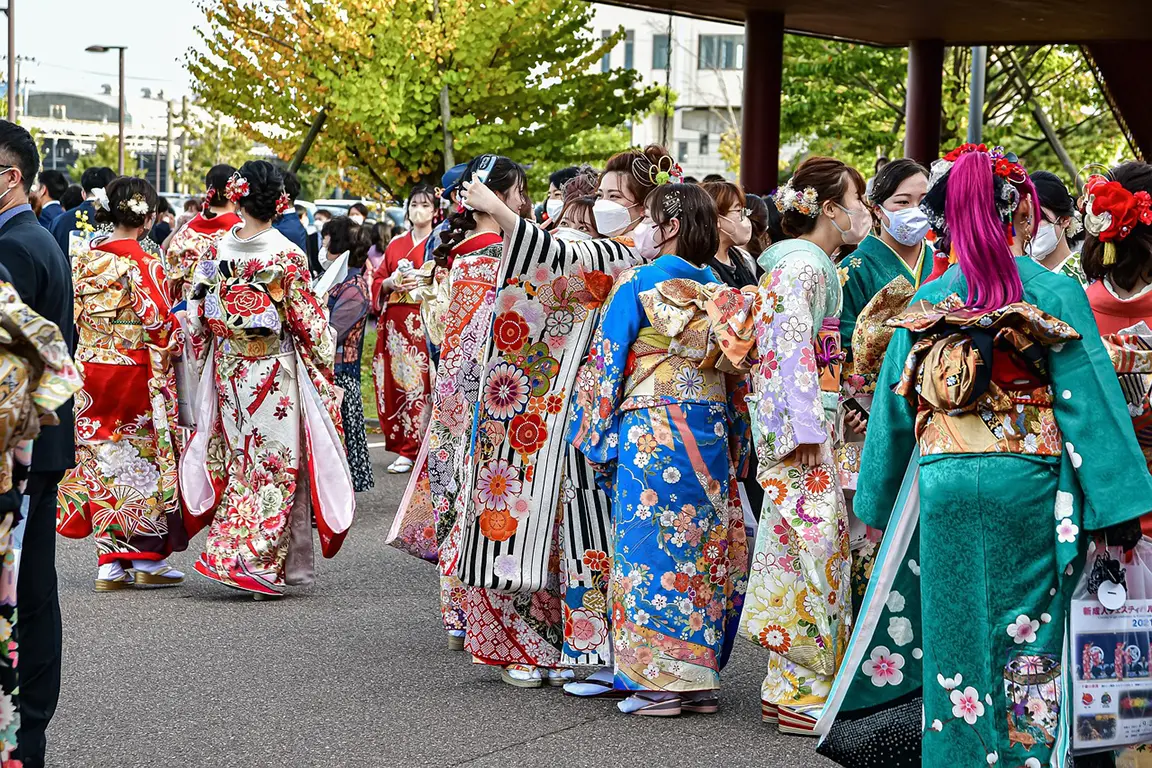
<p>Traditionally, for females on Coming of Age Day, they wear a type of kimono called <i>furisode</i> (振袖). This type of kimono is only worn on very formal occasions and has long sleeves that hang down to the ankles or calves. For men, <i>a hakama</i> (袴) is traditional, but you'll often see them wearing formal western suits instead. </p>

<div class="c-media">
<div class="c-media__image">
<img src="https://www.mitsue.co.jp/english/global_ux/blog/img/20240522_01.webp" width="1152" height="768" alt=""></div>
<p class="c-media__caption -small">A group of women taking pictures with furisode: Photo by <a href="https://pixabay.com/ja/photos/%E3%83%95%E3%82%A1%E3%83%83%E3%82%B7%E3%83%A7%E3%83%B3-%E5%92%8C%E6%9C%8D-%E7%9D%80%E7%89%A9-7477951/">Pixabay</a></p>
</div>

<p>In one part of Japan, however, the dress code is just a little different. In Kitakyushu City, young adults don't just wear traditional clothing - some choose to innovate. There are bright colors and flashy designs, with eccentric hairstyles coming into the mix as well. The Kitakyushu Media Dome held one of the biggest coming-of-age ceremonies this year with about 8,000 new adults attending. The unique styles have gained international attention too. One store located in the Kokura area of the city and which designs and supplies both traditional and distinctively modern clothing for the coming-of-age ceremony, was featured at last year's New York Fashion Week.   </p>

<h2>Sweet 16: Similarities & Differences</h2>

<p>For those who may not be familiar with the custom, Sweet 16 is primarily the celebration of a girl's 16th birthday within and around the US and Canada. How individuals celebrate very much varies. For example, my family and I never made a big deal out of birthdays so for my "Sweet 16" I ate sloppy joes with my friends and family and received some birthday presents, which was fun for me. However, that isn't to say that my case is also the case for everyone else. Many people in America and Canada celebrate their Sweet 16s much more lavishly: For example, by throwing a large extravagant party, the girl dressing up in a beautiful gown, and, although a more traditional custom, participation in a candle-lighting ceremony.  </p>

<p><i>So, what do these two types of coming-of-age traditions have in common?</i>  </p>

<p>Well, while both celebrations share the common theme of transitioning from youth to adulthood, the differences lie in their cultural origins, age, and specific customs. The Sweet 16 emphasizes the individual's 16th birthday, with a focus on personal growth and maturity, celebrated through (sometimes) extravagant parties and rituals. However, Coming of Age Day in Japan emphasizes the celebration of legally defined status as an adult - at age 18 - and is marked by more formal ceremonies that reflect broader cultural values and societal expectations. Both celebrations, however, underscore the universal significance of reaching maturity and undergoing the rite of passage for receiving new rights and responsibilities.  </p>

<p>If you're interested in the previous blog about Japan's holidays (Christmas and New Year's), please see <a href="https://www.mitsue.co.jp/english/global_ux/blog/201612/27_1700.html">Culture Shock: Japan's Winter Holiday Season</a> by Jonathan Weeks (Dec. 27th, 2016).  <br />
</p>]]>
        
    </content>
</entry>

<entry>
    <title>Remote User Testing Amid a Global Pandemic</title>
    <link rel="alternate" type="text/html" href="https://www.mitsue.co.jp/english/global_ux/blog/202003/24_1200.html" />
    <id>tag:www.mitsue.co.jp,2020:/english/global_ux/blog//8.1204</id>

    <published>2020-03-24T03:00:00Z</published>
    <updated>2020-03-24T03:09:00Z</updated>

    <summary>Almost three months have passed since CO...</summary>
    <author>
        <name>Jonathan Weeks</name>
        
    </author>
    
    
    <content type="html" xml:lang="en-us" xml:base="https://www.mitsue.co.jp/english/global_ux/blog/">
        <![CDATA[<p>Almost three months have passed since COVID-19 was first reported to the WHO's Country Office in China. Since then, the outbreak has reached 155 countries and territories around the world, caused widespread disruption and fear, and has been officially declared a pandemic by WHO. Although there is now a global effort to stymie the rate of new cases, we remain in period of growing uncertainty. Whatever happens, the world is sure to face many challenges ahead.</p>]]>
        <![CDATA[<p>Here in Japan, the immediate challenges are already touching many aspects of daily life. Rumors have led to panic-induced buying, particularly of masks, sanitizer and toilet paper. Various attractions and schools are closed nationwide, the latter having a huge effect on working parents. And Japan's traditionally office-based company culture is having to rethink the way it does business, with many companies asking employees to work from home.</p>

<p>As of this writing, Japan has yet to report the kind of rapid community transmission that other countries around the world are now experiencing. But this does not mean that the situation will not deteriorate in the coming weeks.</p>

<p>At Mitsue-Links, many of us are still working from the office, but we have adopted prevention policies to do our part in the global fight against the virus. As is always the case for us every flu season, thorough hand washing and use of hand sanitizer is in practice, along with regular sanitization of desks and equipment. We have also limited out-of-office meetings, most of which now take place through online platforms.</p>

<p>As for UX Research, we are still capable of offering our full spectrum of services, from user interviews to expert evaluations. For the moment, we continue to offer in-person testing at our user testing studio on a case-by-case basis. For these, we carry out strict hygiene procedures to ensure minimal risks for both participants and researchers. These precautions include proper sanitization before entering the facility and the mandatory wearing of masks during sessions. As many of our clients have been restricted from traveling, we are also offering remote viewing for sessions carried out in our user testing studio.</p>

<p>We prefer to run in-person testing where possible, as remote user testing can include its own set of challenges. Issues may arise with equipment and internet connection, participants may feel distanced or unmotivated without face-to-face interaction, and there could be access issues for some participants with low technical literacy.</p>

<p>In spite of these cons, the uncertainty of the future means that we must act with foresight and prepare for the worst. As a result, we have begun implementing remote testing with live English interpretation as an alternative to in-person testing.</p>

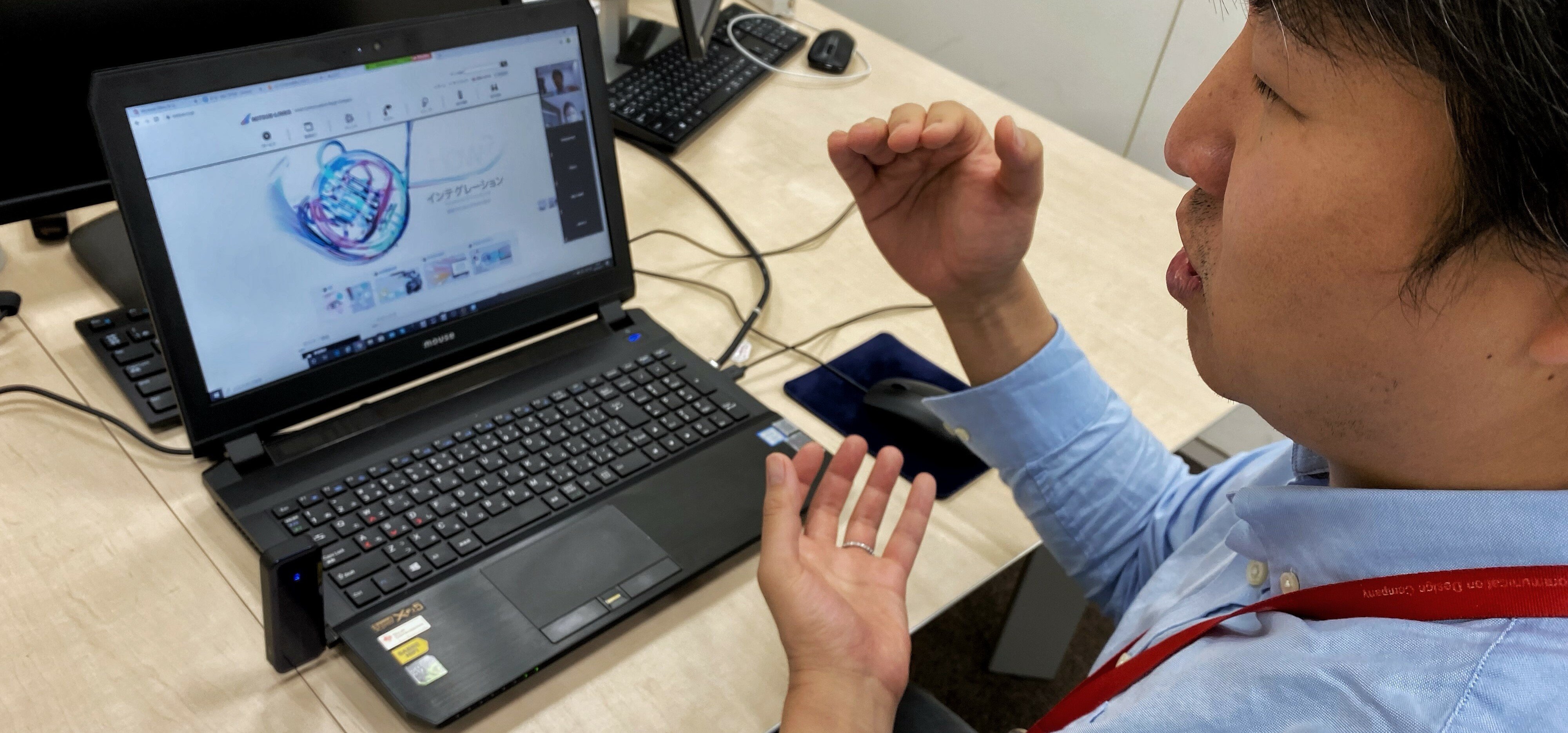
<p><img alt="20200324_01.jpg" src="https://www.mitsue.co.jp/english/global_ux/blog/img/bd9e0fdc05811459712310eb3b3e47910e46893b.jpg" width="4000" height="1870" class="mt-image-center" style="text-align: center; display: block; margin: 0 auto 20px;" /></p>

<p>Our remote testing services are run through the Zoom platform, which has, for us, proven to be the most reliable video conferencing environment. To allow for bilingual sessions, we stream via two channels. One channel displays the original Japanese-language session, while the other provides English interpretation. Our clients can either stream these sessions live or watch the recordings, which can be delivered within a few business days. As a counterbalance to the cons associated with this approach, remote testing gives us the ability to recruit participants at a nationwide level in Japan. It also means observers can watch from any global location, thereby negating travel costs.</p>

<p>No one knows what the future will hold, so it can only be hoped that the situation will improve in the coming months. However, while adversity may often signal times of change, we must consider that not all change is unwelcome. The challenges ahead may be daunting, but they also give us a chance to reevaluate, discover, and hopefully better ourselves for tomorrow.</p>
]]>
    </content>
</entry>

<entry>
    <title>Reporting on UXPA2019: How to connect usability testing to design, Part 3</title>
    <link rel="alternate" type="text/html" href="https://www.mitsue.co.jp/english/global_ux/blog/201910/25_1355.html" />
    <id>tag:www.mitsue.co.jp,2019:/english/global_ux/blog//8.1097</id>

    <published>2019-10-25T04:55:01Z</published>
    <updated>2019-10-25T09:27:15Z</updated>

    <summary>This is the final part of my trilogy of ...</summary>
    <author>
        <name>UXエバンジェリスト 金山</name>
        
    </author>
    
    
    <content type="html" xml:lang="en-us" xml:base="https://www.mitsue.co.jp/english/global_ux/blog/">
        <![CDATA[<p>This is the final part of my trilogy of blog posts on the UXPA poster session. Previously, I discussed how to consider user feedback. By grasping the why behind user actions (facts) during usability testing, you will be in a much better position to solve user problems.</p>]]>
        <![CDATA[<h3>Recap of previous posts</h3>

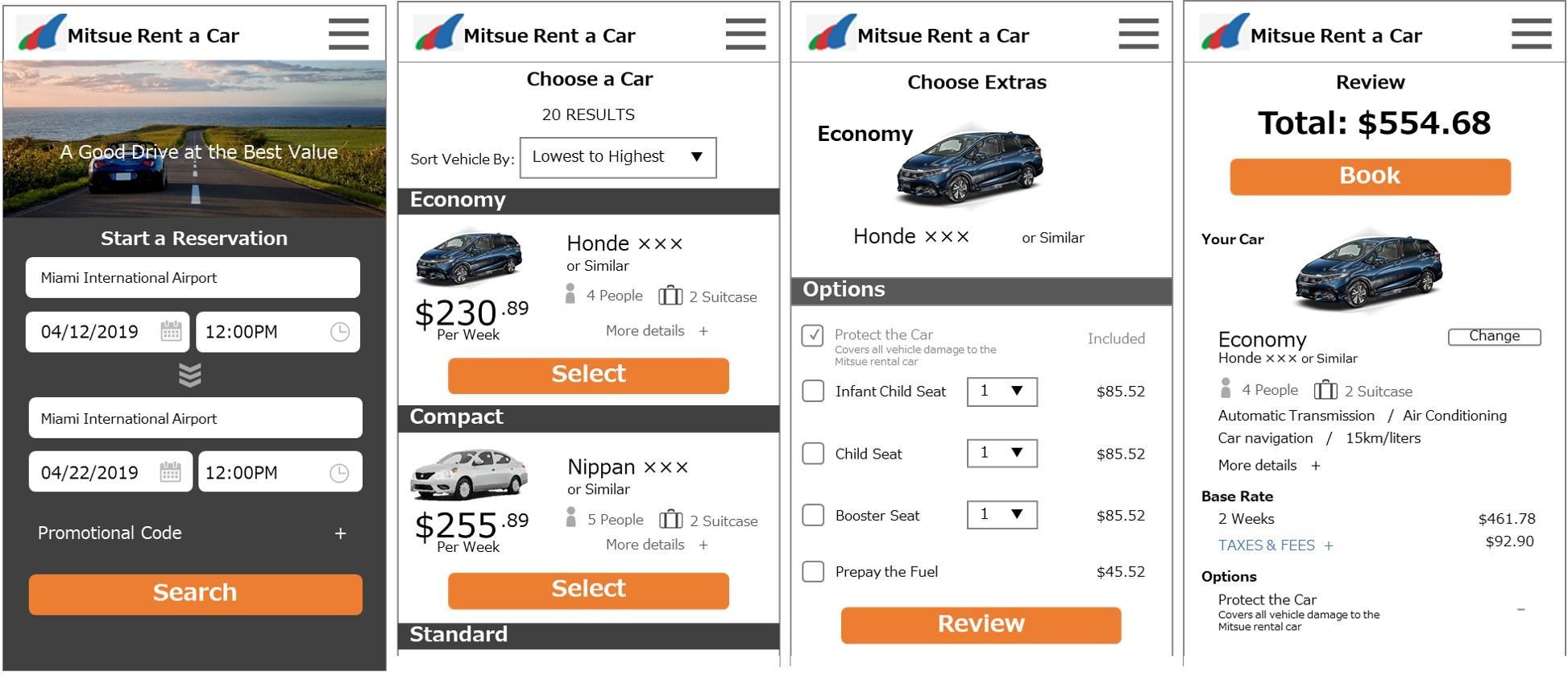
<div class="lyt_image_3"><img alt="Screens of rentacar app" src="https://www.mitsue.co.jp/english/global_ux/blog/img/20191024_01.jpg" width="1946" height="839"></div>

<ul>
<li>during usability testing, users were surprised by the total price on the confirmation page and said that it was difficult to understand total fees</li> 
<li>users were not able to confirm the basic fee structure, so there was a large gap between user perceptions of what the price should be and the actual fees displayed on the confirmation page</li>
<li>approaches such as "making changes to the wording on the confirmation page to inform the user of the fee breakdown" or "providing notice of the calculated rate at an earlier stage" can be taken to solve user problems</li>
</ul>

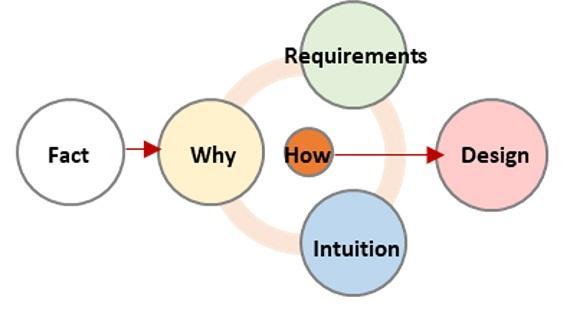
<p>However, to devise a solution that works, ideas formed through intuition as well as requirements including business strategy and system specifications must be considered. This meeting of the whys, intuition, and requirements are where designs that solve user problems can be found. </p>

<div class="lyt_image_3"><img alt="Conceptual diagram from Fact to Design" src="https://www.mitsue.co.jp/english/global_ux/blog/img/20191024_02.jpg" width="588" height="321"></div>

<h3>Dealing with ideas formed through intuition and requirements</h3>
<p>From the viewpoint of a researcher, it's common to assume that after understanding the reasons behind user problems (the whys) they can jump straight to figuring out solutions (the how). However, it's necessary to deal with ideas formed through intuition alongside the requirements. No matter how much thought is put into the reasons behind user problems (the whys), without meeting requirements such as business strategy and system specifications, these solutions cannot be implemented. Furthermore, there may also be times when inspiration comes from observations made during usability testing (the facts). Often these are ideas that researchers come up based on their experience and can be hard to ignore. However, instead of simply adopting those ideas, working through the causes (the why) and requirements before thinking about solutions (the how) and doing some fine-tuning will enable creation of designs that solve user problems. </p>

<h4>Examples of designs based on intuition</h4>
<ul>
<li>can the total price be shown directly on the "select a car" page?</li>
<li>the pages are repetitive. It seems like the content on the options page can be reduced, and users can be shown the total price directly.</li>
</ul> 

<h4>Examples of business strategy and system specifications</h4>
<ul>
<li>the target users, which included those who were recruited for the tests, are those who don't fuss over car specifications.</li>
<li>in order to ensure the lowest prices, there are only 8 car models.</li> 
<li>competitors show prices by weekly rates. If users want to compare weekly rates with competitors it will be disadvantageous if only total fees are shown, so weekly rates should be kept.</li>
<li>the UI flow can be changed provided the location, dates, car model selection, and options are kept for fee calculation purposes.</li>
</ul>

<h3>Connecting with design</h3>
<p>By integrating the identification and understanding of the why, ideas based on intuition, and requirements, the path to solving the problems (the how) will become clearer. In order to realize the how, make changes to the design by fine-tuning the UI.</p>

<h4>Examples of solutions</h4>
<ul>
<li>clearly show how the rate is calculated (whether the rate is 1 week + any additional days, or 2 weeks)</li>
<li>help the user to immediately understand the total price by carefully adjusting the interactions between pages. Make the user journey shorter by having the user select car model upfront and putting options and confirmation of details on the same page.</li>
</ul>

<h4>Examples of specific UI improvements</h4>
<ul>
<li>explain how rates are calculated for the user specified period within the popup box where dates are selected.</li>
<li>make it possible to select a car model upfront. Leave only the minimum required information and request the user selects from the 8 car models by swiping through their options (keep the weekly rates).</li>
<li>assuming the options and confirmation of pricing details can be integrated on the review page, show the total fees directly after the first page.</li> 
<li>the form submission button on the first page says "search" currently, but "get rates" will help the user to understand how rates will be calculated.</li></ul>

<div class="lyt_image_3"><img alt="Improved screens of rentacar app" src="https://www.mitsue.co.jp/english/global_ux/blog/img/20191024_03.jpg" width="1880" height="862"></div>

<p>As can be seen with the above, the proposed solution based on direct user feedback, which was to show the total fees on the car selection page (covered in the first post in this series), is very different from the final suggestions. Because the focus of usability testing is user feedback, which carries much weight, it's easy to fall into the trap of directly implementing user comments into solutions. This often makes solutions too restrictive or impossible to implement due to business or system requirements, in which case the problems that took effort to identify may not be solved. To prevent this, it's important to thoroughly analyze and reason through the context and user ways of thinking behind their words. When business and system requirements are brought to the table, make sure to go back to the root causes, and think flexibly about different possibilities from various angles. In order to achieve a design that solves the user problems found during usability testing, it's essential to fully consider user actions (the facts), ideas formed from intuition, and requirements, rather than merely implementing user feedback directly into solutions. </p>]]>
    </content>
</entry>

<entry>
    <title>Reporting on UXPA2019: How to connect usability testing to design, Part 2</title>
    <link rel="alternate" type="text/html" href="https://www.mitsue.co.jp/english/global_ux/blog/201910/17_1754.html" />
    <id>tag:www.mitsue.co.jp,2019:/english/global_ux/blog//8.1096</id>

    <published>2019-10-17T08:54:33Z</published>
    <updated>2019-10-24T06:58:59Z</updated>

    <summary>As a continuation from my previous post,...</summary>
    <author>
        <name>UXエバンジェリスト 金山</name>
        
    </author>
    
    
    <content type="html" xml:lang="en-us" xml:base="https://www.mitsue.co.jp/english/global_ux/blog/">
        <![CDATA[<p>As a continuation from my previous post, I will continue discussing the content I presented during the UXPA poster session. </p>
<p>Last time, I introduced the tendency to directly incorporate user feedback in design decisions. I explained that this trend may cause discussions to stall if feedback is implemented at the discretion of system requirements and business strategy, or causes the field of design solutions to narrow. </p>
]]>
        <![CDATA[<h3>How to make use of user feedback</h3>
<p>The key to producing designs that solve user problems is to gather the "facts" (user behavior and thoughts) and to then understand the "why" behind those facts. By thoroughly understanding the why, the issues to be resolved should become clear. Even if discussions derail, the why serves as a place to return. To explain, I'll discuss the example car rental site used in my presentation. </p>

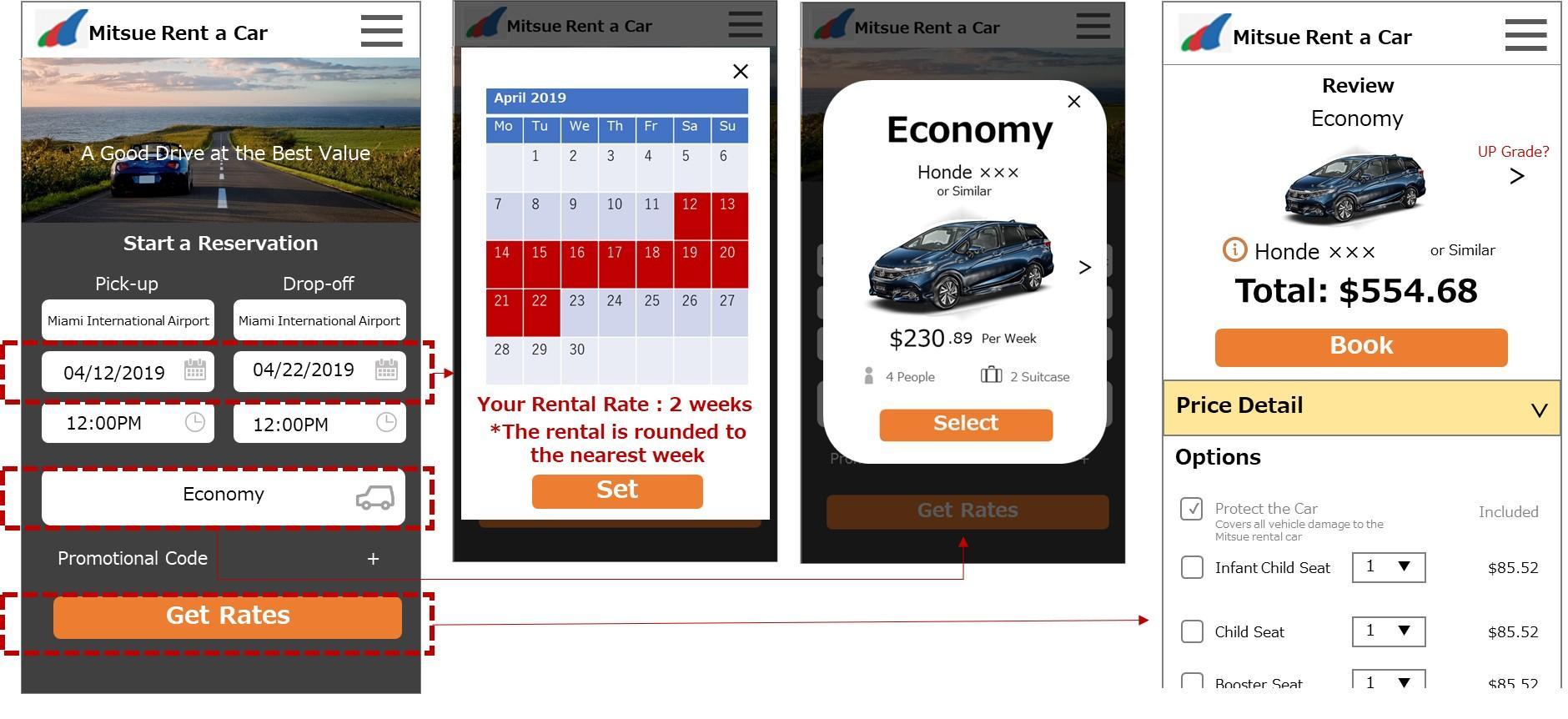
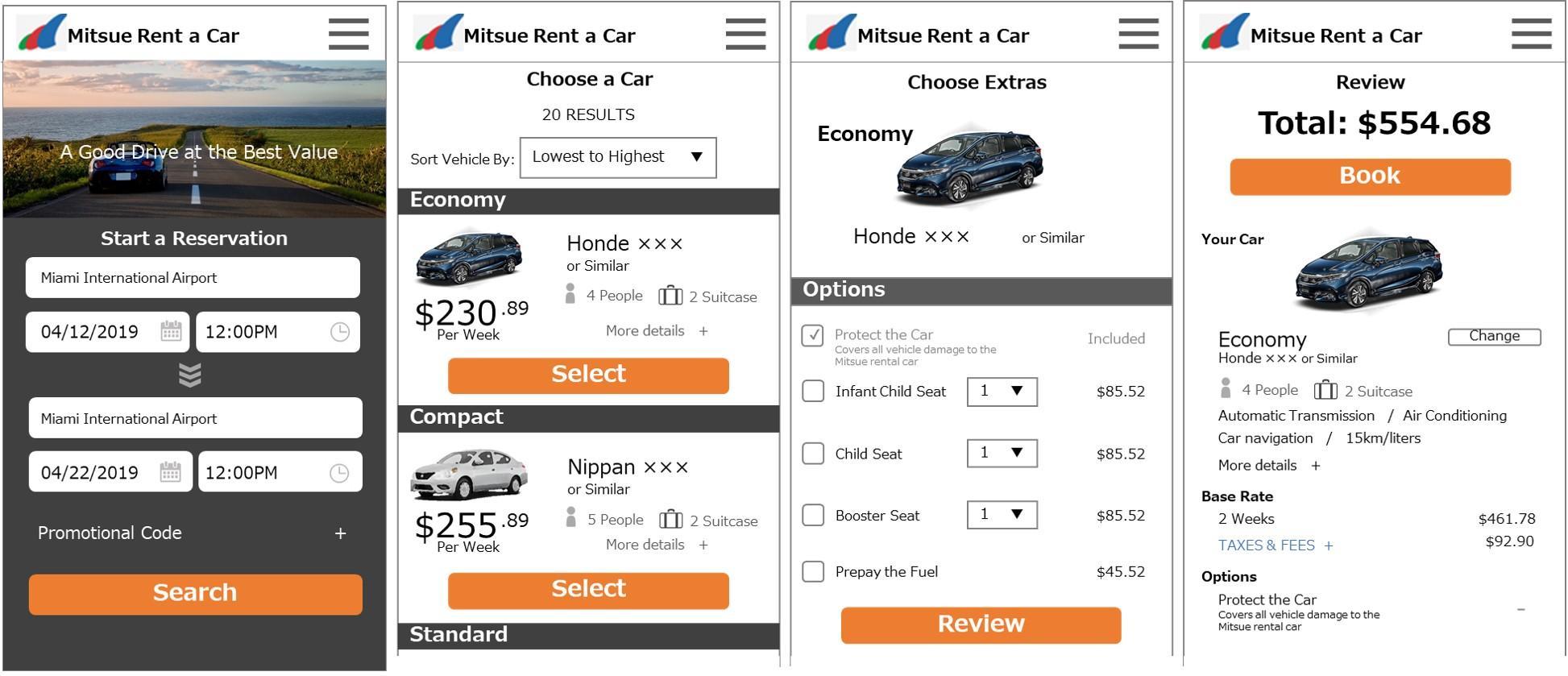
<p>The task for usability testing was to book a car to be picked up and returned at Miami International Airport. The user was asked to rent a car for a trip with three friends between April 11 and April 22, an 11-day period. They could select any model of car they wanted. </p>

<div class="lyt_image_3"><img alt="Screens of rentacar app" src="https://www.mitsue.co.jp/english/global_ux/blog/img/20191017_01-01.jpg" width="1946" height="839"></div>

<h3>Sorting the facts</h3>
<p>To determine the reasons behind problems users encounter during testing, observations of user flows and behavior during testing should be recorded as facts (user behavior and thoughts). Here, it's necessary to think beyond the viewpoints and reasoning of stakeholders and researchers. </p>

<h4>Site flow</h4>
<ul>
<li>prices for different models of car are shown as per week rates, although the user had already selected a rental period of 11 days on the first page.</li> 
<li>afterwards users select car options, the final total price is then shown on the confirmation screen. </li>
<li>the rental price is automatically calculated as the fee for 2 weeks because of a package deal where the total fees for each additional week are discounted if the rental period is longer than 4 days. (For the purposes of this test, the total price includes a 2-week basic rental fee to cover 11 days, plus insurance and state tax).</li>
</ul> 

<h4>Observations from usability testing</h4>
<ul>
<li>there were many users who were surprised by the price shown on the confirmation page and kept going back and forth between the "select a car" and "confirmation" pages. </li>
<li>one user said, "it would be nice if I could see the total price from the beginning".</li>
</ul>

<h3>Determining the why</h3>
<p>Using the gathered facts, think about the usability problems. Focus on deducing the reasons behind actions and comments by asking questions such as "why was the user surprised by the price on the confirmation page?" and "why was the user unsatisfied with the total price?"</p>

<h4>Analyzing the problem</h4>
<p>The basic fee structures were not clearly understood by the user (for the purposes of this test, the rental period was 11 days, so the fees were for 1 week + 4 days and calculated as 2 weeks as explained earlier). On the "Confirmation" page, the price was $554, which was the fee for 2 weeks, plus insurance and tax, but on the "select a car" page, the price was the 1-week fee of $230, which was a major difference. The confirmation page price was nearly double that specified on the "select a car" page. Such a difference confused the user, which was why during testing, they kept going back and forth between the "select a car" and "confirmation" pages, one user also stated that it was difficult to understand the total price. </p>

<p>Once the causes of user problems are understood, proceed to solving them. In this case, there was a significant difference between the actual total price on the "confirmation" page and user perceptions of what the price should be. </p>

<p>Multiple approaches should be considered, such as: </p>
<ul>
<li>making changes to the wording on the "confirmation" page so the user clearly understands the fee breakdown</li>
<li>inform the user how the total price is calculated at an earlier stage</li>
</ul>

<p>However, just understanding the causes of problems (the why) isn't enough to come up with practical design solutions. I will share tips on how to realize such designs in my final post in this series. </p>]]>
    </content>
</entry>

<entry>
    <title>Reporting on UXPA2019: How to connect usability testing to design, Part 1</title>
    <link rel="alternate" type="text/html" href="https://www.mitsue.co.jp/english/global_ux/blog/201909/04_1505.html" />
    <id>tag:www.mitsue.co.jp,2019:/english/global_ux/blog//8.1056</id>

    <published>2019-09-04T06:05:53Z</published>
    <updated>2019-09-19T01:22:47Z</updated>

    <summary>How to connect usability test results to...</summary>
    <author>
        <name>UXエバンジェリスト 金山</name>
        
    </author>
    
    
    <content type="html" xml:lang="en-us" xml:base="https://www.mitsue.co.jp/english/global_ux/blog/">
        <![CDATA[<h3>How to connect usability test results to design</h3>
<p><a href="https://www.mitsue.co.jp/english/knowledge/column/20190726.html">My column about participating in UXPA 2019</a>, a user experience themed conference held June 24-27 in Scottsdale, Arizona, has now been posted. For content I couldn't share there, I will share here and in subsequent posts. Initially, I'll discuss my conference presentation.</p>]]>
        <![CDATA[<h3>About the poster session format</h3>
<p>At the UXPA conference, in addition to lectures, there was a poster presentation session. For the poster session, speakers arranged their posters in a designated room and then, during a specified 1-hour time slot, had dynamic discussions about their work with their audiences. Including mine, there were 14 posters presented at this year's conference.</p>

<h3>The theme of my presentation</h3>
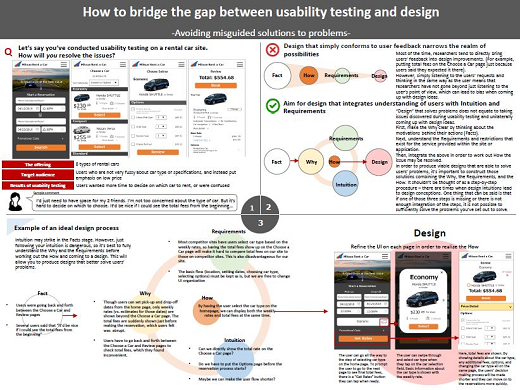
<p>My presentation was titled "how to bridge the gap between usability testing and design - avoiding misguided solutions to problems."</p>
<div class="lyt_image_3"><img alt="" src="https://www.mitsue.co.jp/english/global_ux/blog/img/20190904_01.png" width="520" height="390"></div>
<p>As interest in UX continues to grow, it seems that the idea of delivering the optimal web design to users is becoming more widespread. Recently, it has increasingly become the norm to pinpoint problems by having users trial the website during testing phases as part of the improvement process.</p>
<p>However, even if such usability testing is performed, I've often heard that ascertained problems aren't resolved in the final design. So, what gives?</p>

<h3>The tendency to bring user input directly into design</h3>
<p>Through usability testing, target users provide lots of feedback, which then serves as suggestions for improvement. User researchers do not directly incorporate these comments into design. Instead, they first look through the observations ("facts"). They then think about reasons users took specific actions and made certain comments (the "why") before moving on to identifying problems. However, in cases where no experts in usability are observing the tests, product owners tend to more rigidly follow the user feedback.</p>
<p>As an example, I'll discuss the mock car rental site that I included in my poster. The user selects desired rental dates and location, after which they choose the vehicle model, any optional extras, and then proceed to make the reservation. The total price is shown on the confirmation screen. However, during usability testing many users appeared at a loss because they wanted to select the car model after learning the total price. Consequently, they had to repeatedly move back-and-forth between the reservation confirmation and car model selection screens to do so.</p>

<p>One user said, "it would be nice if I could see the total price from the beginning".</p>

<p>Being feedback from an actual user, this statement is extremely powerful and may be taken directly as something to be improved on. From this statement, it's easy to suggest putting the total price on the screen after the user selects rental dates and location as a fix.</p>
<p>However, if it's not possible to show the total prices upfront due to system requirements and/or business strategy, the discussion reaches a standoff. Even if it is possible, simply listening to the user's request means only thinking in the same way as the user. By doing so, the research team hasn't gone beyond understanding issues from the user's perspective, which can narrow the field in terms of design solutions.</p>
<p>Determining the reasons behind users' actions (the "why") by asking questions such as "why did the user have dissatisfaction regarding total price?" and "for actions that other users took but didn't explain in detail, why did they take such actions?", can help keep options open.</p>
<p>I'll explain how to better employ user feedback to make design improvements in my next UX Blog.</p>

<h3>Related Articles</h3>
<ul>
<li>July 8, 2011 <a href="https://www.mitsue.co.jp/english/knowledge/column/20110708.html">UPA 2011: Designing for the Social Web</a></li>
<li>July 15, 2005 <a href="https://www.mitsue.co.jp/english/knowledge/column/20050715a.html">Participating in the UPA2005 Conference - Considering Usability: Website Designs that Will Never Be Awkward-</a></li>
</ul>]]>
    </content>
</entry>

<entry>
    <title>Cross-Cultural Design in Japan &amp; Colombia</title>
    <link rel="alternate" type="text/html" href="https://www.mitsue.co.jp/english/global_ux/blog/201805/16_1800.html" />
    <id>tag:www.mitsue.co.jp,2018:/english/global_ux/blog//8.723</id>

    <published>2018-05-16T09:00:00Z</published>
    <updated>2020-03-19T09:43:39Z</updated>

    <summary>When talking about UI and UX design it&apos;s...</summary>
    <author>
        <name>Jonathan Weeks</name>
        
    </author>
    
    
    <content type="html" xml:lang="en-us" xml:base="https://www.mitsue.co.jp/english/global_ux/blog/">
        <![CDATA[<p>When talking about UI and UX design it's really important to consider who your audience is going to be and what their wants and needs are. One interesting point to also consider, especially when designing a global product for users from different countries is culture.</p>

<p>My name is Paula Valencia and I am an Interactive Media Design student from Colombia. Currently, I am doing an internship at Mitsue-Links to learn about UX design differences between Japan and my home country.</p>]]>
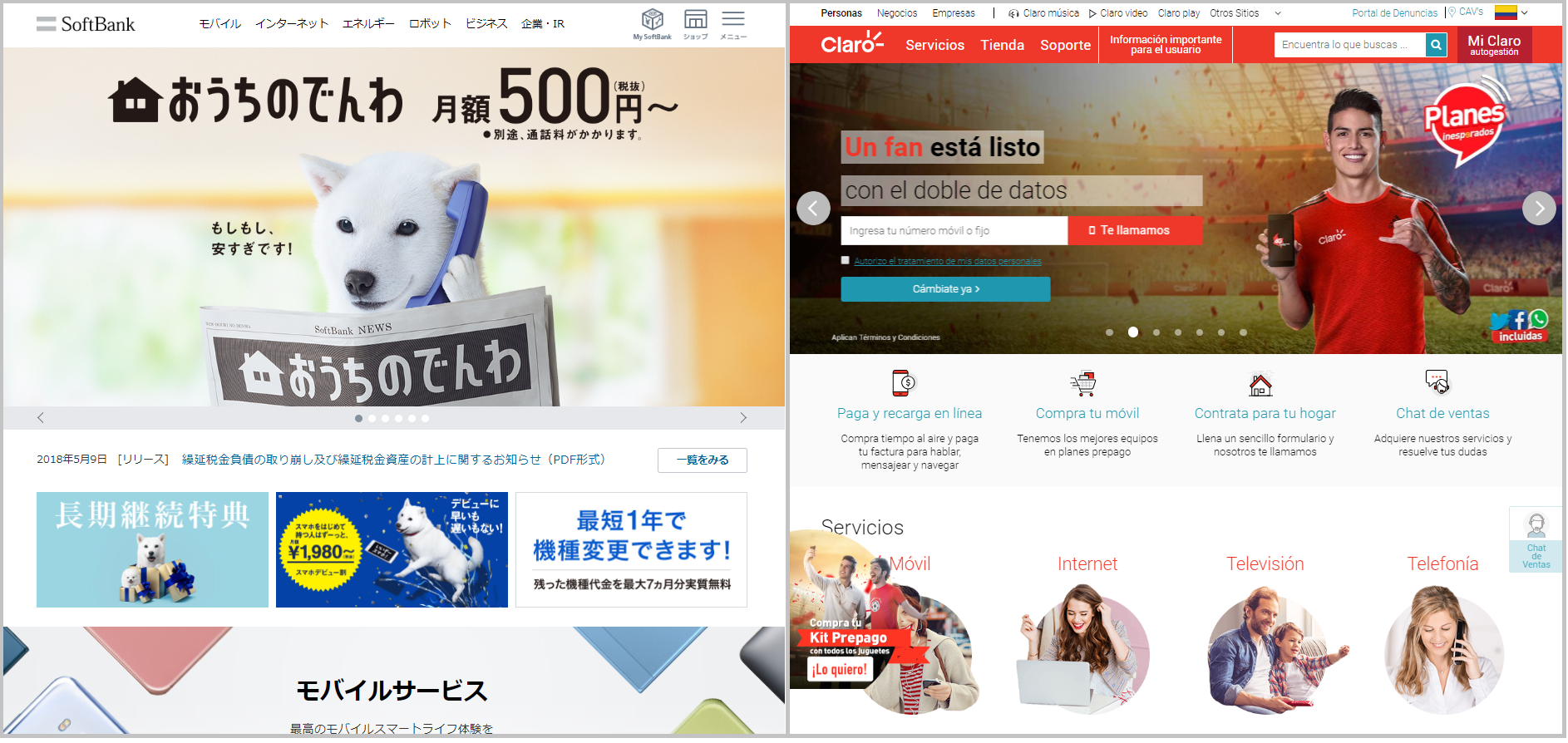
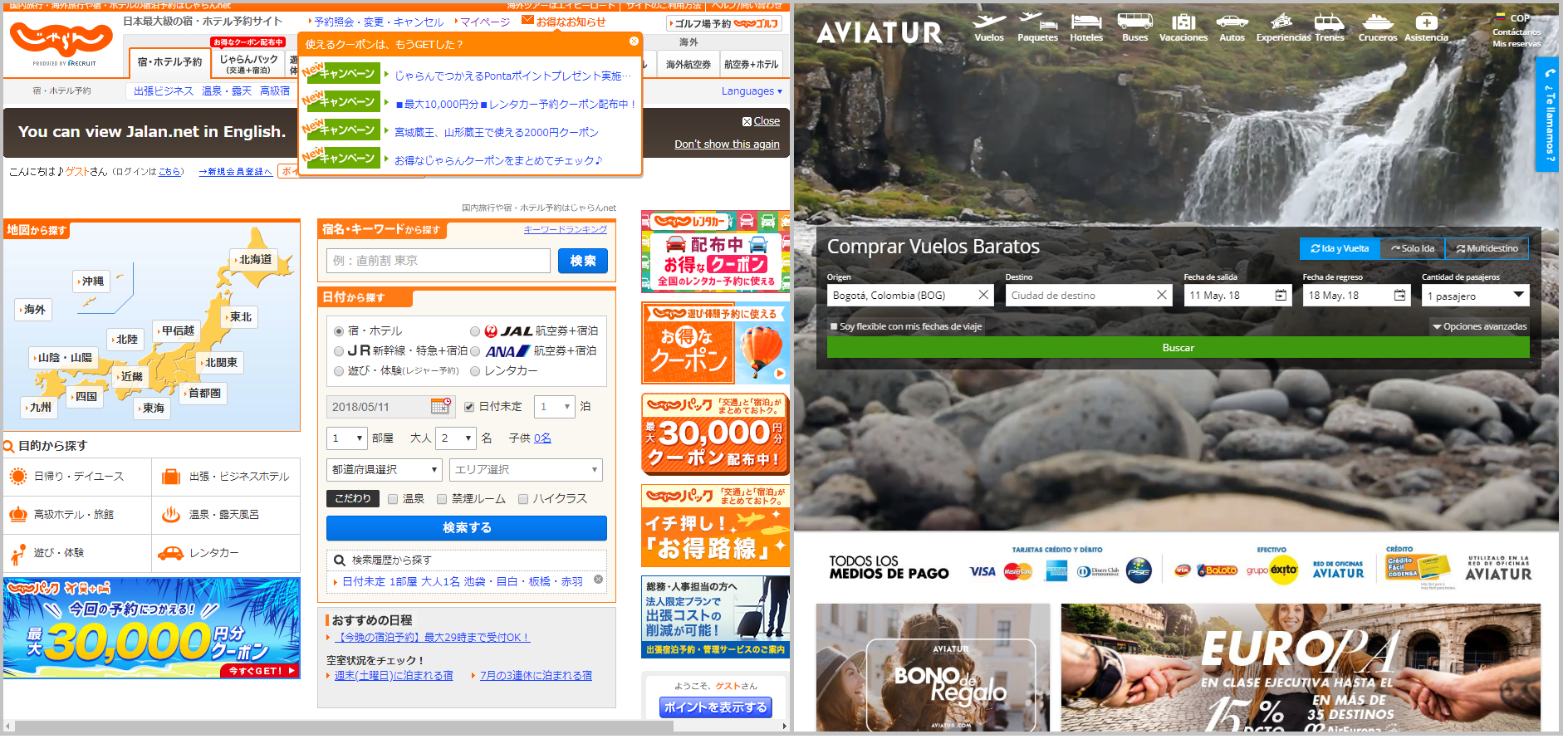
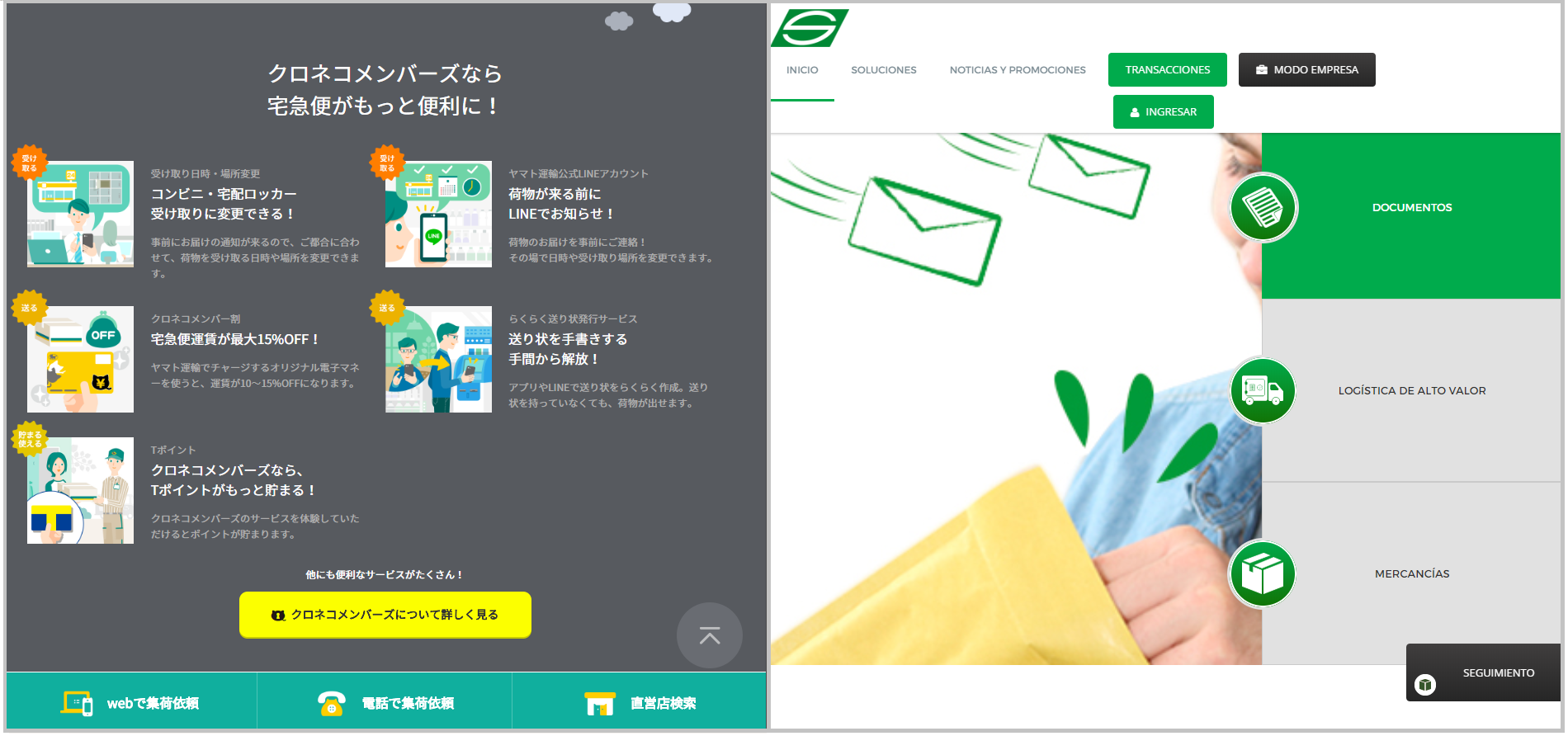
        <![CDATA[<p>During my first month here, I have realized just how different user interfaces can be between countries. For example, while comparing websites in Japan to those from Colombia, I discovered Japanese websites use a lot of colors and contain a lot of detailed information.</p>

<p>Personally, this was confusing to me as I am more used to using clean, minimalist web designs. I wanted to understand more about this difference and how it might affect businesses and their design decisions.</p>

<p>To better understand what factors - cultural or otherwise - make user needs unique across countries, I'll briefly look at 3 features of UX/UI design that differ between Japan and Colombia.</p>

<h3>Emotional Engagement</h3>
<p>Brands attempt to produce emotional engagement through design to create valuable connections that resonate with their user bases. But how does culture play a part in defining what is valuable? Between Japan and Colombia, one of the interesting differences I have noticed so far is Japan's use of mascots or cartoonish characters to represent their brand image.</p>

<p>As an example, Japanese telecommunications giant Softbank often personifies the iconic Hokkaido dog breed, ainu. The dog, and other cartoonish characters common in Japan, are often used to convey cuteness, innocence, and friendliness. But characters such as these may not have the same effect on Colombians, who might perceive them as childish. In contrast to Softbank, the Colombian telecommunications company Claro utilizes people in real-life situations as well as popular celebrities such as football player James Rodriguez, seen in the banner.</p>

<div class="lyt_image_3"><img alt="Picture shows an image of the telecommunications company websites Softbank from Japan and Claro from Colombia" src="https://www.mitsue.co.jp/english/global_ux/blog/img/20180517_01.png" width="1886" height="894"></div>

<h3>Aesthetic Appeal</h3>
<p>In Japan, designs often seem to make use of vertical columns or content areas with a variety of colors and images. Also, marketing content, such as discounts and package deals seem to be overtly displayed in abundance. Colombian style, on the other hand, mirrors the visual aesthetic of Europe and the United States. Websites often employ row-based content areas and a minimalist design.</p>

<p>To illustrate, there is a very noticeable difference between Colombian booking platform, Aviatur, and the Japanese equivalent, Jalan. On Jalan, we can see large white margins on the sides, an extremely detailed navigation bar, and a complex search tool. There are also many bright, vivid colours used throughout the site to draw user attention to content. In contrast, on Aviatur the banner image stretches all the way across the page, the navigation bar is less crowded, and the search tool is simpler. The use of color is also more subtle and limited compared to the Japanese site.</p>

<div class="lyt_image_3"><img alt="Picture shows an image of the travel company websites Jalan from Japan and Aviatur from Colombia" src="https://www.mitsue.co.jp/english/global_ux/blog/img/20180517_02.png" width="1888" height="890"></div>

<h3>Information Appropriacy</h3>
<p>The amount and type of information within a website or app can often be a marker for credibility. If users are not accustomed to the volume of text content displayed on the page, they can form negative impressions. For example, during a recent user testing session I observed for a finance-related website, a participant commented that there was too little information on the homepage. Although the site had simple visuals and was pleasant to look at, the lack of detailed explanations caused this participant to mistrust the site. He was used to finance-related websites having a lot of text, so being shown a homepage with sparse content made him associate the page with popup scam pages.</p>

<p>This participant's comments surprised me, especially since I recently had the opposite experience. Before moving to Japan, I had been looking for a place to live using some Japanese websites. My first impressions navigating these sites was that Japanese web design seemed to favor extremely crowded layouts compared to Colombian sites. Interestingly, because of the overwhelming amount of content, a friend of mine who was helping me search for accommodation on the Japanese pages, was concerned that these websites might be fake.</p>

<p>To illustrate how different the volume of information displayed on Japanese and Colombian websites are, below is a screencap of the transport companies Servientrega from Colombia and Yamato Transport from Japan. Yamato's homepage includes far more detail regarding its services than does Servientrega. Of course, Servientrega also has detailed information about its services, but in order to view this information users must click deeper into the site.</p>

<div class="lyt_image_3"><img alt="Picture shows an image of the travel company websites Jalan from Japan and Aviatur from Colombia" src="https://www.mitsue.co.jp/english/global_ux/blog/img/20180517_03.png" width="1900" height="892"></div>

<p>To conclude, the below is a summary of the web design differences I have observed while watching user tests and interacting with various Japanese websites similar to the above.</p>

<ol>
<li>Emotional engagement on Japanese websites is often created via the use of cute, cartoonish mascot characters. These characters are associated with company brands and help to convey a sense of friendliness and approachability. In contrast, Colombians prefer to use photos of people to create the same favorable website impressions.</li>
<br>
<li>Japanese websites tend to use a lot of bright, vivid colors. This is especially true when a company wants to advertise special campaigns or package deals. While non-Japanese users who are unfamiliar with the Japan market may be overwhelmed by such colorful designs, Japanese people seem to be used to visually complex web pages.</li>
<br>
<li>Japanese are accustomed to using text-heavy websites. One of the reasons for this is because users prefer seeing detailed information upfront, as text volume helps create a sense of trust and credibility. This contrasts with users in Colombia who prefer websites - especially the homepage - to have simple information content. Colombians do not mind needing to dig deeper into the site to retrieve desired content.</li>
</ol>]]>
    </content>
</entry>

<entry>
    <title>Inside the UX Team: Welcoming our New Intern</title>
    <link rel="alternate" type="text/html" href="https://www.mitsue.co.jp/english/global_ux/blog/201804/27_1700.html" />
    <id>tag:www.mitsue.co.jp,2018:/english/global_ux/blog//8.710</id>

    <published>2018-04-27T08:00:00Z</published>
    <updated>2018-04-27T04:19:43Z</updated>

    <summary>This post is part of new series aimed at...</summary>
    <author>
        <name>Jonathan Weeks</name>
        
    </author>
    
    
    <content type="html" xml:lang="en-us" xml:base="https://www.mitsue.co.jp/english/global_ux/blog/">
        <![CDATA[<p>This post is part of new series aimed at getting to know the UX team at Mitsue-Links. April saw the addition of new intern, Paula Valencia, who will be hanging out with us for the next few months. She's a design student from Columbia who is eager to get some first-hand experience in user research.</p>]]>
        <![CDATA[<p><img alt="20170427_01.jpg" src="https://www.mitsue.co.jp/english/global_ux/blog/img/3ee0a7ac2f895c4cb7b99aaf59b9664e1e1e79be.jpg" width="2937" height="1928" class="mt-image-center" style="text-align: center; display: block; margin: 0 auto 20px;"/></p>

<h4>Can you tell us a little bit about your background?</h4>
<p>Well, I was born in Bogota, the capital of Colombia. At the moment, I am an interactive media design student at the Icesi University in Cali, Colombia. I'm currently in my 5th year and will graduate this August just after finishing my internship. This is my first time working in a big company and I think it's a little challenging but really interesting as well.</p>

<p>I consider myself a curious person, so I like to learn about as many new things as possible. As an interactive media design major, I have been able to study a diverse range of topics, including graphic design, user experience, information architecture, corporate identity brand design, motion graphics and video editing. However, my concentration has been in web/app design and development.</p>

<h4>What is your interest in user experience?</h4>
<p>As I mentioned before, my major covers a lot of different skills. Most of my projects try to involve every process in the development cycle, such as brainstorming, wireframing, high and low-fidelity prototypes, user testing, analysis, etc. So, sometimes it feels like I'm just getting very general knowledge in those areas and I don't get to focus on anything specific.</p>

<p>I think learning the whole process has been beneficial and allowed me to develop a passion for many skill areas. But now that I have the opportunity to specifically focus on one area, I'm really excited to acquire more knowledge about UX research. Testing with Japanese users is also a great way to develop my understanding of the culture. I've already sat through a couple of UX studies here and some of the insights were really eye-opening to me. I'm excited to see more user behaviors and learn about their wants and needs.</p>

<h4>Why did you choose to come to Japan?</h4>
<p>So actually, this is my second time in Japan. About a year ago, I won a scholarship to participate in an exchange program at Nihon University in Mishima, Shizuoka. Basically, I decided to come back because of how impressed I was with this country. It's such a different place from Colombia, so everyday was kind of like a new adventure. One of my favorite things is the mixture of old and new. Like when you're walking around the city and suddenly you find a temple. You kind of feel like you've been transported to somewhere else.</p>

<p>I guess my interest in Japan started when I was about 11 years old. In Colombia, anime it's pretty popular and it's readily available on television. Culturally, it was a really different from anything I had experienced before and that really drew me in. When I was 14, I decided to start learning Japanese and that expanded my fascination. When the opportunity came to move to Japan for the exchange program I jumped at it. Of course I wanted to improve my Japanese and knowledge of the culture, but it was also a chance for me to see things from fresh perspectives.</p> 

<p><br />
</p>]]>
    </content>
</entry>

<entry>
    <title>Will the Zozosuit Revolutionize Online Shopping?</title>
    <link rel="alternate" type="text/html" href="https://www.mitsue.co.jp/english/global_ux/blog/201802/26_1600.html" />
    <id>tag:www.mitsue.co.jp,2018:/english/global_ux/blog//8.668</id>

    <published>2018-02-26T07:00:00Z</published>
    <updated>2018-02-28T00:22:50Z</updated>

    <summary>In my previous post, I discussed the eff...</summary>
    <author>
        <name>Jonathan Weeks</name>
        
    </author>
    
    
    <content type="html" xml:lang="en-us" xml:base="https://www.mitsue.co.jp/english/global_ux/blog/">
        <![CDATA[<p>In my previous post, I discussed the effects of the so-called <a href="https://www.mitsue.co.jp/english/global_ux/blog/201801/19_1400.html" target="_blank" title="gala">Galapagos Syndrome</a> on Japanese innovation. In many cases, overly focusing on the idiosyncrasies of the local market meant Japanese companies were unable to scale globally and were sometimes overtaken by international competition.</p>]]>
        <![CDATA[<p>As a follow-up, I thought it would be interesting to consider an innovative Japanese company that is about to launch a first-of-its-kind service. <a href="https://www.starttoday.jp/en/" target="_blank" title="start">Start Today Co., Ltd.</a> is the owner of Zozotown, the largest e-commerce retailer in Japan. The company is credited with pioneering online fashion shopping in Japan, a concept that most people thought wouldn't stick.</p>

<p>In November, they announced the release of the Zozosuit, a skin-tight elasticated bodysuit with 15,000 embedded sensors. These sensors record the user's body measurements and upload them via Bluetooth to a proprietary app. The measurements can then be used on Zozotown's shopping portal.</p>
<div class="lyt_youtube"><div class="youtube"><iframe width="560" height="315" src="https://www.youtube.com/embed/wlLqB5kEEU4" frameborder="0" allow="autoplay; encrypted-media" allowfullscreen></iframe></div></div>

<p>This technology was developed in partnership with New Zealand startup <a href="https://www.stretchsense.com/" target="_blank" title="stretch">StretchSense</a>, who plans to apply the smart tech in a number of ways. At present, the Zozosuit is being offered for free and is available for pre-order in Japan and various other countries.</p>

<p>The company also launched their own clothing brand called ZOZO, which can be fully tailored based on the user's Zozosuit specifications. The brand's line-up is minimal for now, consisting of only t-shirts and denim jeans. </p>

<p>If the company's endeavor is successful, it not only has a chance to revolutionize the industry but to scale itself internationally as well. The only problem with the latter is the question of how it plans to reach foreign customers. As of now, Zozotown's official website and app are still only available in Japanese.</p>

<p>Will Start Today be able to attract a global user base or will international competition overshadow this potential? It seems for the moment that the Zozosuit is in a league of its own, but for how long? Last year already saw rumors that Amazon had patented an <a href="https://www.ft.com/content/795935ac-0205-11e8-9650-9c0ad2d7c5b5" target="_blank" title="amazon">automated clothing factory</a>, which would give the company the ability to custom tailor their own clothing line. </p>

<p>However, if the current pace of progress set by Start Today is any indication of future success, my guess is that the company has a good grasp on how to tackle international expansion. For those interested in knowing more about Start Today, here is a list of their latest innovations:</p>

<ul>
<li>My Size Search: users of Zozotown's website and app can search for clothing that best matches their Zozosuit size specifications.</li>
<li>Personal styling service: in this subscription-based service, fashion advisors assemble recommended outfits for users based on preferences such as patterns, colors, size, and budget.</li>
<li>Deferred payment option: users can pay for an item 2 months after delivery.</li>
<li>Choose your shipping fee: this was a brief campaign that the company used to set a new standard shipping fee. While the current cost of shipping is a flat rate of 200 yen, the company has promised to better its logistics with the aim of lowering the fee to 100 yen.</li>
<li>Not long after making the above promise, the company announced the expansion of its logistics center Zozobase.</li>
<li>Zozotown products can now be delivered to a <a href="http://www.packcity.co.jp/our_service" target="_blank" title="pudo">Pudo Station</a>. The Pudo Station is a set of package delivery lockers within public locations like train stations, supermarkets, and drugstores. Customers can specify which Pudo Station to have packages delivered to and can pick up the items in their own time and at their own convenience. The Pudo Station is a new service offered by Parkcity Japan.</li>
</ul>
]]>
    </content>
</entry>

<entry>
    <title>Galapagos Syndrome and the Birth of Tap and Go Experiences</title>
    <link rel="alternate" type="text/html" href="https://www.mitsue.co.jp/english/global_ux/blog/201801/19_1400.html" />
    <id>tag:www.mitsue.co.jp,2018:/english/global_ux/blog//8.636</id>

    <published>2018-01-19T05:00:00Z</published>
    <updated>2018-01-19T04:07:55Z</updated>

    <summary>These days, it&apos;s difficult to ignore the...</summary>
    <author>
        <name>Jonathan Weeks</name>
        
    </author>
    
    
    <content type="html" xml:lang="en-us" xml:base="https://www.mitsue.co.jp/english/global_ux/blog/">
        <![CDATA[<p>These days, it's difficult to ignore the rise in contactless payment systems such as Apple Pay, Google Wallet, and Android Pay. Their ease of use and convenience have lead to great user experiences that are now transforming the way we interact with point of purchase systems. But despite the recentness of these services, the technology behind them has its roots in Japan and goes back much farther.</p>]]>
        <![CDATA[<p>Japan is a unique place. As an expat, there have been a myriad of cultural differences to assimilate to. Even after four years, the depth of these idiosyncrasies still at times astounds me. Some distinctions are overt, such as efficiency and punctuality, the quality and attention to detail of services, or the architectural mix of archaic and modern. But other things exist beyond the surface: things like behavioral attributes, cultural taboos, different laws, or economic underpinnings.</p>

<p>As for the world of business and tech, there is an almost contradictory mix of speed and innovation with a tendency to loyally adhere to traditional principles. One interesting phenomenon within this space is what has come to be known as Galapagos Syndrome. This is a reference to Charles Darwin's work in the Galapagos Islands, where he discovered that isolation could lead to the evolution of wholly unique species of flora and fauna.</p>

<p>Similar to what Darwin found in the Galapagos, there are many instances where technology in Japan has developed in isolation on a path of its own. Japan's economic and innovative power allowed it to create revolutionary products, which, in some cases, long proceeded such developments in other countries. However, these products remained strictly available in Japan. 

<p>One example of this was DoCoMo's 1999 release of the first commercial mobile internet service, i-mode. It's success in Japan lead to interest by several other countries around the world. But due to various issues, including compatibility, the service never took off globally, and Japan was left alone to develop extremely rich feature phones that enabled users to browse web pages and send emails long before the iPhone, or other smartphones, entered the market.</p>

<p>Another innovation that Japan helped pioneer was contactless payment systems. Ahead of its time, Sony developed the FeliCa (short for Felicity Card), which uses radio-frequency identification (RFID). You may have heard of similar systems powering your smartphone e-money tech called NFC (near field communication). Both are subsets of RFID systems.
FeliCa technology was first used in 1997 in the Octopus card for Hong Kong's public railway system. It's popularity lead to the creation of Japan's own version, the Suica card, which could be used on trains run by the Japan Railways East Company.</p>

<p><img alt="picture shows contactless payment cards and Suica on Apple Pay" src="https://www.mitsue.co.jp/english/global_ux/blog/img/20180119_01.jpg" width="720" height="438" class="mt-image-center" style="text-align: center; display: block; margin: 0 auto 20px;" /></p>

<p>Since then, these transportation smart cards, now known as IC cards, have become ubiquitous. Other than serving as train passes, they can be used on many bus lines and in an increasing number of taxis as well. They can also be used for vending machines, coin lockers, and shopping at hundreds of thousands of stores and restaurants all over the country.</p>

<p>Aside from IC cards, there are also a number of other prepaid contactless smart cards in Japan such as Edy by Rakuten, Nanaco by Seven & I Holdings, and QUICPay by JCB. These allow users to make purchases at participating stores while simultaneously collecting redeemable points. The collection of points is a highly valued aspect in Japanese retail commerce.</p>

<p>Physical IC cards were not the only thing that Japan developed in this field. They were also first to introduce mobile payments with the Osaifu Keitai or "wallet phone" in 2004. This was a full ten years before Apple Pay was released.</p>

<p>Using FeliCa technology, the Osaifu Keitai offered similar, if not more, features as Apple Pay and its contemporaries. Users were able to register all of their physical contactless payment cards to their mobile and pay at designated areas. Readers for this service were already widely available due to the popularity of the physical IC cards.</p>

<p>Similar to i-mode, the Osaifu Keitai never gained traction abroad. It remained popular in Japan until 2007 with the release of Apple's iPhone. iPhone's were not compatible with FeliCa technology until the iPhone 7, when Apple realized  that supporting FeliCa was a key step in successfully <a href="https://www.computerworld.com/article/3117105/mobile-wireless/apple-reportedly-eyes-sonys-felica-rfid-for-the-iphone-7.html" target="_blank" title="apple pay">launching Apple Pay in Japan</a> and allow the phones to also serve as transit passes.</p>

<p>Along with contactless payment and e-money, Japan has also been a pace setter for <a href="http://www.nytimes.com/2009/07/20/technology/20cell.html" target="_blank" title="camera phone">camera phones, 3G networks, mobile music downloads, and digital TV services</a>. These innovations enjoyed enormous local success. And in spite of Japan's attempt to replicate the success abroad, there were a number of issues that prevented global adoption. One of these, as theorized by Yoichi Washida at the Ericsson Business Innovation 2013 conference, was an <a href="https://www.computerdealernews.com/news/why-japans-mobile-tech-industry-cant-rise-to-global-dominance/30375" target="_blank" title="design">oversight in design importance</a>.</p>

<p>Another, as pointed out in <a href="http://www2.itif.org/2014-galapagos-chinese-ict.pdf" target="_blank" title="paper">a paper</a>  by the Information Technology & Innovation Foundation (ITIF), was that companies in Japan decided to develop their own technology standards instead of adhering to global norms. They did this for two reasons. One was to create domestic advantages against foreign competitors. Second, they hoped that other countries would adopt their new standards.</p>

<p>However, other countries did not adopt Japan's new standards but instead opted for internationalized ones. And in not adopting, all the innovation that had been developed for the Japanese market was essentially non-transferable to global markets. This eventually lead to early leaders in Japan falling far behind their international counterparts.</p>

<p>Given Japan is still a hugely innovative nation, Galapagos Syndrome isn't necessarily a negative thing, but more of a lesson to be learned from. As an example of new technology on the horizon, take a look at CNN's interactive site  titled <a href="http://edition.cnn.com/interactive/asia/vision-japan/#sv1" target="_blank" title="CNN">Vision - The Future of Japan</a>. But to avoid developing technologies that are incompatible or not adaptable globally, companies will need to open themselves to international standards and modes of thinking.</p>

<p>Galapagos Syndrome is not something that only affects Japanese companies. It goes both ways. A lot of big foreign companies have met with success in Japan (Apple, Amazon, and Netflix to name a few) but that doesn't mean it's easy to replicate. Just as the evolution of Japanese products and services have made it difficult for these companies to transfer abroad, so too has it made some foreign products and services difficult sells in the domestic market. Success in Japan often means extreme sensitivity to what my co-workers have often referred to as "Japanese sense". Understanding the local market in all its various layers is imperative.</p>
]]>
    </content>
</entry>

<entry>
    <title>Mobile Qualitative Research Takeaways from the JMRA Annual Conference 2017</title>
    <link rel="alternate" type="text/html" href="https://www.mitsue.co.jp/english/global_ux/blog/201712/18_1600.html" />
    <id>tag:www.mitsue.co.jp,2017:/english/knowledge/blog/ux//8.615</id>

    <published>2017-12-18T07:00:00Z</published>
    <updated>2018-01-05T10:04:32Z</updated>

    <summary>On November 28, I attended the JMRA (Jap...</summary>
    <author>
        <name>Jonathan Weeks</name>
        
    </author>
    
    
    <content type="html" xml:lang="en-us" xml:base="https://www.mitsue.co.jp/english/global_ux/blog/">
        <![CDATA[<p>On November 28, I attended the JMRA (Japan Marketing Research Association) Annual Conference hosted at the Hyatt Regency Tokyo. The event, held since 2005, provides participants the opportunity to learn about the latest global trends and developments in the marketing research industry. This year's talks were based on the theme "Fusion &amp; Creation - Creating New Value", and looked at how marketing research today is not only about data analysis but about using advanced technologies and new research methods to bring more valuable customer insights to clients.</p>]]>
        <![CDATA[<p>As a UX Researcher, I was interested in learning about popular global research methods since the toolbox that market and UX researchers draw from often overlap. For example, both use interviews, surveys, focus groups and other methods to collect information and learn about target audiences. Below are some of the takeaways from Dorrie Paynter's talk on "Qualitative Research in the US".</p>

<div class="lyt_image_3"><img alt="picture shows stage and a waiting audience at JRMA Annual Conference" src="https://www.mitsue.co.jp/english/global_ux/blog/img/20171218_01.jpg" width="520px" height="533"></div>

<h4>Digital Ethnography as a Solution to the Limitations of Face-to-face Research</h4>
<p>With clients wanting in-depth and actionable insights into their customers faster than ever, the use of digital ethnography in qualitative research is steadily rising. In this method, participants use their own smartphones to record in-the-moment snapshots of their own customer journeys (or other experiences pertaining to a study goal). Collecting data with this approach is a powerful way to overcome limitations associated with face-to-face data collection. For example, digital ethnography helps overcome the following limitations associated with in-person interviews:</p>

<ul>
<li><strong>Time constraints:</strong> the time needed to procure and setup a facility and to schedule in-person interviews is eliminated. Using their own smartphone devices, participants are free to record and share their experiences at their own convenience.</li>
<li><strong>Reliance on memory:</strong> for face-to-face interviews, researchers often need to rely on written notes to recall and report findings. With digital ethnography, researchers can directly share participant-recorded experiences.</li>
<li><strong>Participant responses being affected by a location or the presence of others:</strong> Peoples' demonstrated behaviour in a lab facility can vary from what they usually do. Their responses to questions can also be affected by how comfortable they are in the presence of researchers and observers. Digital ethnography enables participants to more freely express their thoughts and opinions while being in their natural surroundings and in the absence of strangers.</li>
<li><strong>Location constraints:</strong> when conducting face-to-face interviews, recruitment of participants often needs to be narrowed down to a certain city for logistical reasons. With mobile research, participants can be recruited from anywhere and cover a much larger geographic area.</li>
</ul>

<h4>Scenarios for Using Mobile Research</h4>
<p>Apart from overcoming limitations associated with face-to-face interviews, digital ethnography is useful for hybrid studies. It enables clients to see real examples from participants about the what, where, when, how and why questions that pertain to a study. Below are some scenarios where mobile research can be useful for gathering quick, initial findings before the start of the main study.</p>

<ul>
<li>Completing pre-study homework in challenging environments - for example, asking participants to do a 1 week journal to capture issues they face when driving in different situations or places</li>
<li>Taking researchers on a video tour of places where bringing a researchers or observers along is not feasible - for example, asking participants to show us their office work space</li>
<li>Showing researchers how they do certain tasks - for example, asking participants to make a video to show us their in-store shopping experience while selecting and buying a certain product at their supermarket</li>
<li>Doing a diary-type study to explore reactions to a product - for example, asking participants to record the ways they and their family use paper towels</li>
</ul>

<h4>Summary of the Benefits of Digital Ethnography</strong></h4>
<p>As seen above, there are many use cases where mobile research can be beneficial, especially when capturing findings from a challenging environment is necessary or desired. Below is wrap-up of the main advantages associated with conducting digital ethnography:</p>
<ul>
<li>Moderators, observers and participants can engage in research from anywhere, anytime</li>
<li>Rich data can be easily collected in the form of mixed media (text, photos, videos and audio)</li>
<li>It allows researchers and participants to capture experiences in the moment</li>
<li>Researchers can learn from a single person (or many participants) multiple times at different stages of a process or experience</li>
<li>Mobile research removes the need to rely on memory. Participants can use their devices to record, show and tell us what they do instead of just recounting their experiences</li>
<li>Video recordings from mobile research allow us to see context and motion</li>
<li>Participants have fewer inhibitions when voicing and sharing their experiences using their smartphone devices versus when they are in a lab environment</li>
<li>Mobile research is often more cost-friendly and time-efficient than other qualitative research methods. Researchers can watch and learn from participants remotely, which saves travel time and money</li>
</ul>

<div class="lyt_image_3"><img alt="image shows Dorrie Paynter speaking on stage." src="https://www.mitsue.co.jp/english/global_ux/blog/img/20171218_02.jpg" width="520px" height="370"></div>

<h4>Challenges of Conducting Mobile Research in Japan</h4>
<p>During the talk, it was interesting to learn that Dorrie had conducted smartphone-based research not only in the US but also in Japan. So at the end of the session, I took the opportunity to ask if there were any cultural challenges she and her team faced. Apart from language-related issues and finding a mobile app that was suitable for conducting a study with Japanese users, it seemed that one of the unique aspects of mobile research in Japan is needing to consider how to put participants at ease.</p>

<p>While people in the US are quite open to accepting unexpected requests to video record and self-narrate an experience as it occurs in the moment, Japanese people need a bit of warning. This is because they tend to be more conscious of their appearance and surroundings, and would not want to look untidy nor want to inconvenience others while they video record something. For example, taking a video on your mobile phone while talking and simultaneously walking down a busy public street can be seen as rude in Japan. This is due to the potential nuisance you could cause others; with your attention divided, you might accidentally run into other people or others might need to go out of their way to avoid bumping into you. So to avoid causing any discomfort and awkwardness for Japanese participants, and to make local research go more smoothly, it is always best to inform Japanese people of any required tasks before a study begins so they can properly prepare themselves or share their potential concerns in advance.</p>]]>
    </content>
</entry>

</feed>